Willoughby: Roan deserves protection

For years, Colorado TU and our Grand Valley Anglers chapter have been working to protect and enhance habitat for native cutthroat trout atop the Roan Plateau.  From involvement in a legal challenge against a BLM oil and gas leasing plan that lacked adequate protections for watersheds, to volunteer work days with fencing and riparian restoration - from water quality monitoring and securing "outstanding water" protections, to construction of a fish barrier to secure native trout habitat from invasion by non-native brookies - TU has been, and continues to be, hard at work in protecting this unique place within Colorado. As part of a four-part series on some of Colorado's best wild lands and efforts to conserve them, Scott Willoughby of the Denver Post recently took notice of the efforts by TU and our partners on the Roan.  TU's Corey Fisher noted some of the challenges:  "Our Grand Valley chapter out of Grand Junction has been working on stream restoration projects up there for over 15 years, so our engagement up there in fisheries conservation goes back long before the oil and gas issue really got going on the Roan.  But those leases and areas that could be developed theoretically could cover the entire top of the plateau, including all the trout streams up there."

Read Scott Willoughby's full Sunday feature on the Roan here.

Meet Stephanie Scott, Outreach Coordinator in Colorado

Stephanie is the Outreach Coordinator for Colorado TU. She has been with CTU since January 2013 and has been kicking butt ever since!! As the Outreach Coordinator Stephanie has her hand in a little bit of everything both with Colorado TU and National TU projects in Colorado. One of her main responsibilities is working with the 24 local CO chapters to engage TU members and their surrounding communities in conservation. Each chapter is very unique which requires a lot of coordination between her and the individual chapters. Stephanie is also responsible for organizing and running most of the public policy projects across the state. She works very closely with Colorado TU's lobbyist, Jen Boulton during the Legislative Session to help connect TU members to the bills that Jen is working on. Stephanie also works closely with National TU staff on getting members engaged on Federal legislation such as the Browns Canyon National Monument designation and the Clean Water Act. Stephanie comes from the National Audubon Society where she coordinated their grassroots efforts and managed all of their conservation programs in Colorado. She graduated from Metropolitan State University of Denver with a BS in Biology with an emphasis in Zoology. During her undergraduate work OLYMPUS DIGITAL CAMERAshe has also taken wildlife management courses in South Africa through the University of Pretoria, studied zoology and field research techniques in Australia at the University of Tasmania, and studied forest ecology in Costa Rica. For her senior research project she studied the correlation between climate change and the transmission rate of West Nile Virus in the raptor species of Colorado, and also designed a lab at her University to study mate selection behavior in Convict Cichlids; which students are still conducting research in today. She is also a certified Geographic Information Systems (GIS) Analyst. Stephanie lives in Thornton with her husband Tyler and their 95lb lap dog Roscoe.

Trout Unlimited Partners With the Forest Service to Restore

The U.S. Forest Service (USFS) along with residents, local governments, other agencies and many others, have a long road ahead of them to restore what was damaged during the 2013 floods in Northern Colorado. To begin this process the USFS needs to assess the damage of the rivers. They have turned to Trout Unlimited (TU) because we have an expansive network of dedicated volunteers that care about the watershed and want to make a difference.

FS Training smartphones

This is the beginning of a multi year partnership to bring back the healthy river ecosystems in the South Platte Basin after the floods; and we already have volunteers trained and ready to get on the river!!

The USFS hosted the first training for TU members on August 20, 2013, and it was a huge success. Dan Cenderelli and Matt Fairchild from the Forest Service developed a unique scientific assessment aimed at gathering data to develop a prescription to restore the entire watershed. This assessment is unique in many ways, but the big one is that there is an app for it!! Yes, an app for your smart phone. TU volunteers were not only trained on the science of the assessment, but also how to enter the data into their phones and instantly submit their results into the USFS database.

TU and the USFS were very anxious to get this project going. Planning and developing this partnership began shortly after the floods in September 2013. We are excited that the first bunch of volunteers have been trained and are ready to get out on the rivers and be true citizen scientist.

Because of the high demand from volunteers we will be hosting another training. We are working on scheduling it and should have details ASAP. If you are interested in being a part of this ground breaking partnership then please let us know. Contact Stephanie Scott at sscott@tu.org or 720-354-2647 to learn more and get signed up.


Sportsmen Fly to DC to Protect U.S. Rivers

Beginning in 1972, all waters with a significant nexus to navigable waters were covered by the Clean Water Act (CWA).  While navigable waters has been an oft used phrase the EPA has also defined covered waters as Waters of the Unites States (WOTUS) that include territorial seas. This spring and summer the EPA has been working on a rewrite of definitions in answer to the suggestions by the Court.  Those efforts have caused a flurry of activity by many affected interest groups.  Some environmental groups are fully in support of anything the EPA can put in place to further define, protect or expand WOTUS.  Some Industry and Agriculture folk are vigorously opposed to a rewrite of regulations that in any way increases the reach of the federal government.  Some Municipalities are concerned that without well thought out language, new regulations could have a major and costly impact as they have to deal with both ends of the pipe – providing potable water and treating wastewater.  Finally, there is the pure politics of the issue.  There are those that want nothing more than to see the EPA’s rewrite efforts stopped for no other reason than to showcase it as a failure of the current administration.

On July 15th and 16th Dick Jefferies, President of the Rocky Mountain Flycasters Trout Unlimited chapter, joined13 other Sportsman representatives to discuss with elected officials the importance of not allowing politics to win out over sound and accepted procedure and policy.  Currently, any policy can be changed if consequences or outcomes realized from policy implementation cause harm.  There are many documented cases where provisions within the CWA have been successfully challenged.  There are also many cases whereby regulatory provision was upheld.  The simple fact of the matter is the process of challenging provisions that you disagree with cannot be considered if the definitions are not allowed to be created.  Thus we end up where we are at today.  Extremely muddled and ambiguous guidelines that are difficult and expensive to navigate through or use efficiently in project planning.

On March 25th of this year the EPA and the Army Corp proposed a rule for public comment.  That proposal makes a strong effort to more clearly define what waters are covered and equally, if not more important, what waters are not covered.  However, the EPA needs to do an even better job of providing clarity in all of the descriptions, classifications and definitions.  Furthermore it is vital that flexibility be incorporated that allows for regional considerations.  Water issues and water law in the Western United States force us to address issues in ways that can be entirely different than those found in States that have an abundance of water and do not manage water through a prior appropriation system.

Allowing politics to win out by gutting the efforts to rewrite these definitions is the wrong approach and the worst outcome possible.  Let’s hope that common sense can overcome politics.  After all, it’s true that some things don’t change.  Take care of the water and it will take care of you!

The EPA needs to hear from you!! To comment on the proposed rule click here to tell the EPA to protect our streams and rivers!!

Hidden Treasure Mine Decommissioning and Rehabilitating Project

Saturday, August 23, 2014 We are calling for a maximum of 20 hearty CCTU volunteers to join forces with the Coalition for the Upper South Platte and the city of Alma to complete the  Hidden Treasure Mine, aka. Orange Fence Mine Decommissioning and Rehabilitating Project.  By closing access and rehabbing the site, this work will both help to preserve the historical aspects of the area, populations of rare plants recently discovered at the site as well as to improve water quality of Buckskin Creek  and ultimately the important fishery of the Middle Fork of the South Platte River.

Where and When:  We plan to meet on Saturday, August 23rd at 9:00 AM at the Alma Town Hall located at 59 Buckskin Street, Alma, CO 80420.  There is a lot of work to do so we are planning on working till 2:00PM.  

Lunch!  A BBQ Lunch  will be provided by a generous supporter for all volunteers.

Project Description:  Work will include rehabilitating the  abandoned mine site on USFS property 4 miles  outside of Alma on County road 8..  The site has significant erosion issues exacerbated by illegal digging with heavy equipment.  Runoff flows over tailings and goes subterranean before entering Buckskin Creek, which then drains into the Middle Fork of the Upper South Platte.   Part of the project entails creating a diversion to curtail water moving over the tailings.  The illegal use activity also created access point for off road vehicles, multiplying the damage.  Work will minimize the issues through decommissioning the site, re-seeding with native perennials, transplanting trees and shrubs.  This work will  reduce degradation of this ‘attractive nuisance’ and enhance regeneration at this polluted site, improving downstream water quality. The Town of Alma will donate heavy equipment and staff for the project, CUSP will donate staff and seed, and a generous supporter will provide a BBQ lunch.  This project will be completed through genuine dedication of key local community members and committed efforts of CCTU volunteers.  Please plan to join us on this collaborative and impact-full effort.

Important Notes:

CUSP will provide materials and necessary tools to complete project work.

Events may be canceled or rescheduled due to bad weather, which could create hazardous conditions for volunteers and staff.  Staff will monitor weather and notify you of any changes in a timely fashion.


Please Bring:

Any applicable medicines (including epi-pen and inhalers, if needed)

Sun block and sun glasses (or safety glasses)

Layered clothing appropriate for outdoor work

Waterproof work boots

Work Gloves

A container for water, the use of reusable containers is encouraged, refills will be provided


Please Call Jim Klug at 303-565-7504 to sign up and to arrange for car-pooling.

Where the wild things are: Hermosa Creek among best

Coloradans, perhaps better than anyone, understand and appreciate just how special the wilderness can be. And as connoisseurs of the outdoors, they recognize there are not only wild places, but there are best wild places. These are the places that inspire — some acknowledged and held sacred, others that have managed to remain under the radar. Others still find themselves perched in a sort of purgatory somewhere in between.

Hermosa Creek, in the San Juan National forest just north of Durango, might qualify among those in-betweeners. To Durango locals, the drainage that translates to "beautiful" creek epitomizes the Colorado outdoor experience, and they'd like to see it remain that way. But those who don't frequent the Four Corners region may not be aware of all that this hidden gem has to offer.

Count the majority of U.S. Congress among that latter group. For more than a year now, a bipartisan bill known as the Hermosa Creek Watershed Protection Act has languished in the legislative branch of our federal government as a consensus of local stakeholders await acknowledgment of efforts to preserve the attributes that make the place so special.

"The primary thing the bill does is it takes the basin and protects it exactly as it is today," said Ty Churchwell, backcountry coordinator for Trout Unlimited's Sportsmen's Conservation Project. "This bill is completely supported by consensus from all stakeholders — everyone from county commissioners and town boards to sportsmen, miners, mountain bikers and motorized users. There's nothing for them to do in D.C. but vote it forward."

Read the rest from Scott Willoughby in The Denver Post.

Climate Change is Heating Up Along With Colorado Water

Climate change has been a hot topic the last few years and it’s about to heat up once again. The Colorado Climate Change report states that Colorado is warming up. But how will air temperature affect the water quality and fishing in Colorado? The report was  done for the Colorado Water Conservation Board, Western Water Assessment, Cooperative Institute for Research in Environmental sciences and the University of Colorado at Boulder with funding from a grant the NOAA Climate Program Office.

Temperatures have been rising over the last 30 years due to increasing concentrations of greenhouse gases in the atmosphere. These changes in the atmosphere and temperature are affecting the water supply in Colorado and its basins.Temperature Change

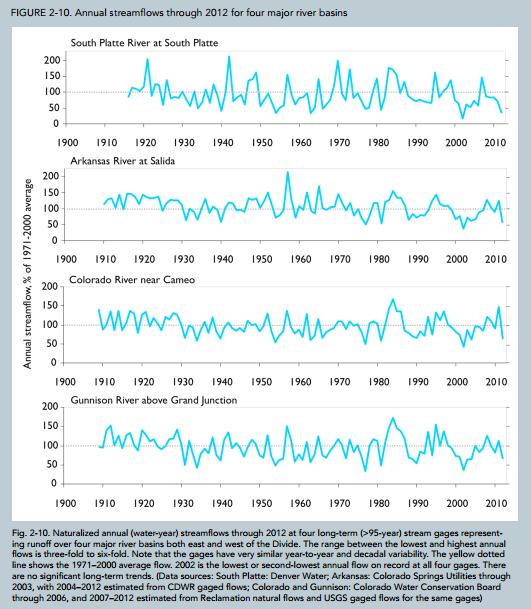
With the increase in temperature in the entire region, the snow packs will begin to melt one to three weeks earlier in the year than normal. This will result in lower flow periods later in the summer due to the shift in peak periods. Although the runoff will occur earlier, there is less certainty that the amount of runoff will change.

With the change in flows, the procedures of reservoirs and draining may be changed to counter the lower periods of flow.  Reservoirs will be forced to keep flows downstream, therefore changing the flood control and water storage operations.

Streamflow changesWith a lower water supply and higher temperatures, the amount of water needed for crops will increase, consequently reducing the amount of stream flow. According to the Colorado Climate Report, “Warming temperatures could increase the loss of water from plants and soil, lengthen growing seasons, and increase overall water demand.”

The ground water available for agriculture will also be depleted and the recharge rate will decrease due to lower amounts of precipitation every year. If the groundwater is used too much and is unable to recharge in time, more water will be used from the rivers, resulting in even lower stream flows.

These higher temperatures will also affect the quality of the ecosystems. The warmer temperatures will lead to warmer water temperature, resulting in spreading of invasive species. Particularly the spreading into higher mountain streams.

The patterns of fish and other aquatic species will change with the increasing water temperatures. This will lead to a difference in fishing throughout the state. Rainbow trout prefer a water temperature between 55 and 60 degrees Fahrenheit; the change in temperature will force the fish to adjust accordingly. The spawning times will change and the fish would move into higher mountain streams where the water may be cooler.

For more information, read the Colorado Climate Report or the Executive Summary version of the report.


Clean Water Act worth bolstering, says Summit County Commissioner

Summit County Commissioner Karn Stiegelmeier penned an op-ed piece that ran in the Denver Post on August 4th, supporting the proposed new "Waters of the United States" rulemaking by the EPA as an important step in improving the effectiveness and efficiency of Clean Water Act permitting processes.  The piece is well worth the read, and you can find it online by clicking here. The EPA rulemaking is a key step in ensuring that headwater and feeder streams, which may not flow year-round, are still afforded protection under the Clean Water Act. Commissioner Stiegelmeier sums up the bottom line for Summit County and Colorado as a whole: "Healthy waterways benefit the whole state by protecting and enhancing recreational opportunities. For those of us living and working in Summit County, protecting our waters means protecting our clean water and our tourism economy. The proposed rule is a thoughtfully crafted, urgently needed clarification to protect Colorado's waterways."

The EPA is taking public comment on the Waters of the United States through October.  You can add your voice in support of protecting headwater streams by visiting our action alert and submitting your comments to the EPA, and sharing them with your Senators and US Representative.

Rio Grande Cutthroat: A Colorado Treasure

In 1951, Francisco de Coronado and his expedition went west looking for cities of gold. They never found the fabled cities, but they did find another treasure: the Rio Grande Cutthroat Trout. The Rio Grand cutthroat (RGCT) is a subspecies from the Colorado River cutthroat around 70,000 years ago. Both species of fish share a common ancestor, the Rainbow trout. Around 2 million years ago, the Colorado River cutthroat branched off from the rainbow.

Rio Grande cutthroats only occupy 10-12 percent of its historic range. Due to these low populations, the species is a candidate for protection under the Endangered Species Act of 1973.

Different factors have contributed to the decrease in population of RGCT over the previous years; the biggest factors being environmental changes, mining development and the introduction of non-native trout species.

Rainbow trout as well as brown and brook trout were all released into the same areas as the Rio Grand cutthroat. In return, this led to more competition for habitat and prey amongst the species. These other species of trout also have the ability to hybridize with the RGCT and make vulnerable the genetic make up for the population.

The RGCT generally lives to between five and eight years old and are between 10”-15” in length. In some lakes, they can reach over 20”.  The fish present red and orange on their underbelly, transferring into a yellow along the sides, with a green coloration on the back.

rio grande cutthroatAlthough these fish are decreasing in population, with help from Colorado TU and Colorado Parks and Wildlife, there are over 80 recreational populations throughout the Rio Grande basin in Colorado. CPW helps maintain these populations through stocking.

To help improve the entire population of RGCT, Colorado TU and CPW and working together to help restore habitat, improve streamflow as well as other projects to help improve the Rio Grande cutthroat species.

Colorado TU also appreciates any angler feedback about this wonderful species, therefore we ask you to take a few minutes for a brief survey about the RGCT.

For more information on how to help protect this beautiful species of trout, contact Kevin Terry at Kterry@tu.org or check out the Colorado Parks and Wildlife conservation strategy.

Colorado TU Recognizes Colorado River Day

The Colorado River is recognized by American Rivers as one of as one of the most endangered rivers in the country. Restoration efforts, including those by Colorado TU and other non-profit agencies have been in full force to help protect the Colorado. On July 25, 2014, the same day Congress renamed the river from the Grand to the Colorado back in 1921 the states of Colorado, Nevada, New Mexico and Arizona are celebrating Colorado River Day.

Colorado River Day is when urban and rural organizations and progressives and conservative groups come together to celebrate the river and unite in support of maintaining the sustainability of the Colorado River.

Colorado RiverThe Colorado begins in Colorado at the Continental Divide and runs west through seven different states. The river supplies roughly 36 million Americans with clean drinking water, supports roughly 15% of the nation’s agriculture and provides recreation that accounts for about $26 billion annually into the economy.

The high demand on the river is depleting the resources and usually the river completely dries up before it can reach the Sea of Cortez and the Pacific Ocean. The depletion of water has lead to the endangerment of many fish species living in the river system including the Colorado pikeminnow, razorback sucker, humpback chub and bonytail.

Colorado TU is the leading voice in Colorado dedicated to the conservation efforts of the Colorado River. Colorado TU is working on many different projects dedicated to protecting the waters of the mighty Colorado including the Moffat Expansion Project, Blue River restoration, Windy Gap Firming Project and the Fraser River project.

Currently chapters west of the Divide are working on projects that will help restore the Colorado River and its tributaries. The Ferdinand and Hayden Chapter is helping put on a river clean up where volunteers will help pick up trash along the Roaring Fork and Colorado Rivers in Glenwood Springs and Glenwood Canyon.

For more information or to help volunteer for this event and help save the Colorado River, click here.

With assist from Trout Unlimited members, and other conservation organizations, Colorado TU can help restore the Colorado River back into the life force it once was and hopefully one day, the waters of the Colorado will reach the Sea of Cortez year after year.