JANUARY 4, 2018 – The National Fish and Wildlife Foundation (NFWF) has recently announced their slate of awardees for the competitive Bring Back the Natives Grant (BBN)– a program that will provide $1 million in grants to support habitat restoration and other on-the-ground projects that advance recovery goals of native fish throughout the United States in 2018-19. A partnership between NFWF, the U.S. Forest Service, U.S. Fish and Wildlife Service, Bureau of Land Management, Bass Pro Shops and the Brunswick Public Foundation, “Bring Back the Natives represents the benefits of coordinated efforts between private landowners and federal agencies to improve the health of watersheds,” said Jeff Trandahl, executive director and CEO, NFWF.

As one of the 15 grant recipients, Colorado Parks and Wildlife (CPW) will receive $60,000 to support the design and construction of a critical temporary fish barrier on Cornelius Creek. Located in the US Forest Service Canyon Lakes Ranger District (USFS-CLRD), the George and Cornelius Creek drainage is one of the most significant Greenback Cutthroat recovery sites to date.
The Greenback cutthroat trout is currently listed as “Threatened” under the Endangered Species Act, and is believed to have been endemic to coldwater streams and lakes of the South Platte River Basin. Once a thriving species, the Greenback has suffered significant impacts from human development, competition from non-native fish, and the introduction of whirling disease. Once thought to be extinct, the native trout is making a comeback thanks to a coalition of state and federal agencies, non-profits, private landowners, and public volunteers.

The George and Cornelius Creek watershed has been identified as a high priority for establishing a robust Greenback cutthroat trout metapopulation. Due to its relatively low elevation compared to that of many other streams in the basin where cutthroat trout reintroduction may be feasible, these creeks feature thermal conditions that fall within an optimal range for cutthroat trout recruitment. Additionally, these streams are already managed for a Greenback cutthroat trout recovery population with regard to the Endangered Species Act, Section 7.

Due to the complexity of the habitat within the drainage, Colorado Parks and Wildlife and the US Forest Service will take on the project in stages. With the presence of both whirling disease (WD) and non-native fish in the area, biologists will build three temporary barriers that will segment the two tributaries and allow for effective treatment over the next few years. Once the streams have been cleared of WD and non-native competitors, the Greenbacks will be introduced. This process is expected to take several years.
The desired outcome of the entire multi-phase project is successful establishment of a self-sustaining Greenback cutthroat trout population in 14 miles of connected habitat. At this writing, Greenbacks only occur in the wild in four waters, three of which are the result of recent introductions.
The Greenback Cutthroat Trout Recovery Plan (US Fish & Wildlife Service 1998), although in the early stages of being updated, calls for—among several other requirements—stable Greenback populations in at least 31 stream miles in order for the species to be considered for de-listing. Currently, there are no stream populations in the South Platte Basin that meet the Recovery Plan’s criteria for “stable conservation populations.” Therefore, the importance of the George and Cornelius Creek Project, which is slated to create up to 14 miles of such habitat, cannot be overstated.

The Cornelius Creek barrier is essential to the overall success of the project by enabling CPW biologists to treat the upper section of the creek while concurrent restoration work is being completed in the other units. With the funding provided by the NFWF Bring Back the Natives Grant, CPW will now have the resources necessary to move forward in this critical recovery effort and secure a large drainage for the Greenback.
Note: Due to various treatment protocols for Whirling Disease (which has been found in the area), the entire project will likely be completed near 2026. The barriers will be in place by the end of 2019. For more information, please contact Dan Omasta, CTU Grassroots Coordinator (domasta@tu.org).
For more information on the NFWF BBN Grant and other recipients, Click Here.



 CPW set up at the Zimmerman Lake inlet to capture spawning Greenbacks.
 Fish were collected with a large net and put into a pen to be sorted and categorized by CPW staff and volunteers.
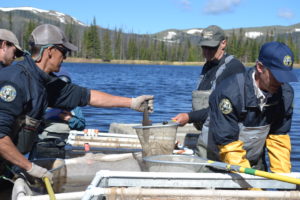 Fish were sorted based on their gender and stocking year.
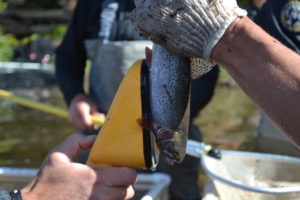 RFID chips in the fish help to identify the stocking year and other critical data.
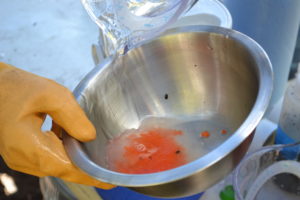 After the fish were sorted, CPW milked the males and females - making targeted genetic crosses among the various lineages to expand the genetic diversity. The eggs and sperm were combined in bowls, packed into small coolers, put on ice, and shipped to the local fish hatchery in Leadville, CO for breeding.
 Monday was the first full day of camp and after waking up, the kids went to the stream and pond at the ranch to learn about the entomology of the watershed. The kids took bug samples to learn about what the fish would be eating in the area and took water samples to determine the health of the stream and pond. After the sampling, students ate lunch and headed to nearby North Lake to fish for the afternoon. It wasn't long before kids started hooking into fish and in the first day over half of the kids had landed their first fish of the camp and for some, their first fish ever.
 Over the first few days the kids had free time to tie flies and practice their fly fishing skills and on Wednesday they had a chance to hone in those skills and use the flies they have tied. The day started off by traveling to North Lake for the morning. While at North Lake kids were catching fish left and right and by halfway through the morning, everyone had caught a fish. After returning to the camp, the kids ate lunch and broke up into teams of three for some additional fishing. One group headed to some beaver ponds, another group fished the stream, and the third group fished a lake on the ranch property.
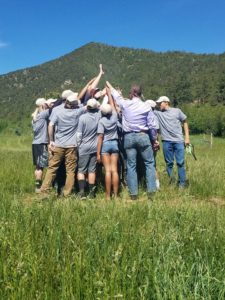 When the 15 campers arrived on June 11, there were nervous faces and uneasy feelings about what to expect for the upcoming week. But just a few days later on June 16 the campers had a hard time leaving one another. The friendships formed, the lessons learned, and the memories made will carry on forever and many students mentioned coming back in 2018.
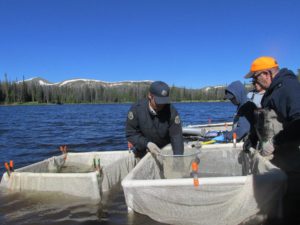 In the South Platte basin, Colorado TU and chapters worked to engage young, inner city, girls through the great outdoors by introducing them to fly fishing and conservation; CTU worked with Colorado Parks and Wildlife to reintroduce the Colorado state fish, Greenback Cutthroat Trout, to it's native watershed along the Front Range; Trout Unlimited tackled abandoned mine issues, and various chapters worked to repair their homewater streams from the devastating floods of 2013.
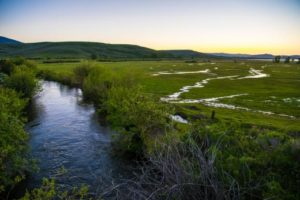 In the Colorado River basin, TU helped secure protections for the Roan Plateau and Thompson Divide from harmful oil and gas development, worked with local ranchers and farmers to improve the health of the Upper Colorado while enhancing agriculture water usage. TU also helped lead the Learning by Doing initiative that, among other things, secured $8 million in funds to protect and restore the Upper Colorado River.
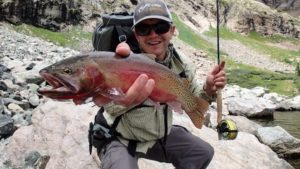 In the Rio Grande basin, Trout Unlimited worked to protect the Great Sand Dunes Cutthroat from potential changes in the environment. The Rocky Mountain Flyathlon came to Saguache for the annual race and fishing events that help raise money for Colorado TU's work in protecting native trout and their habitats. The local chapter and Trout Unlimited also worked to repair sections of the Conejos and ensure that winter flows were hospitable for trout.
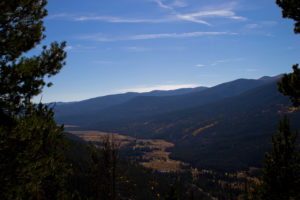 TU staff along with Grand County and a number of environmental organizations discouraged the leasing of these parcels that were close to both the Colorado River and Rocky Mountain National Park. These areas also contained cutthroat trout habitat. TU and partners commented on the potential impact to the wildlife resources and recreation in the area to the BLM throughout the NEPA process. The other organizations who commented on these potential leases played a large role in the removal of these parcels, but the sportsmen’s perspective that TU provides seemed to be especially influential in many of these efforts.