
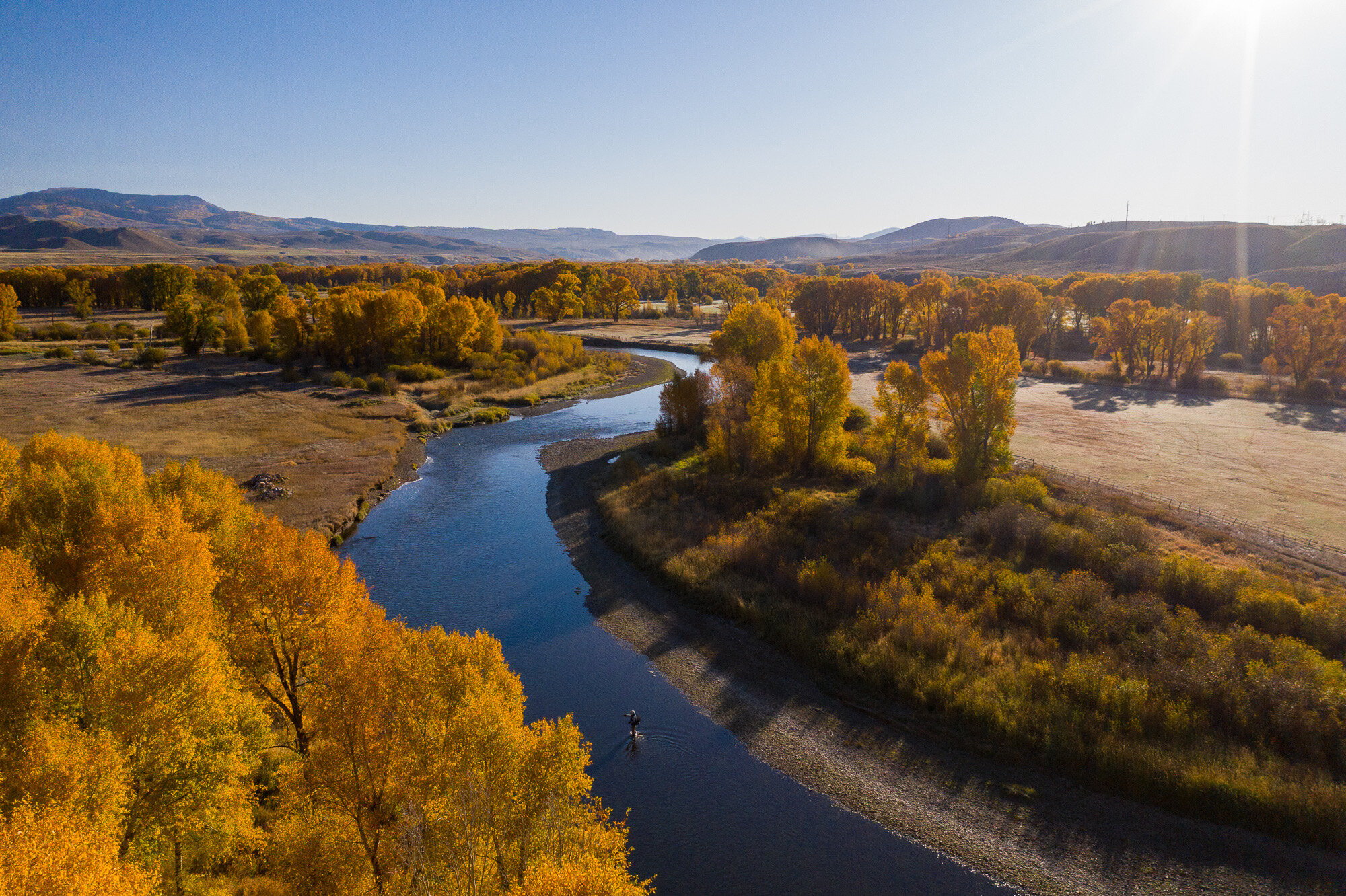
Colorado Trout Unlimited has been a proud partner of a Trout in the Classroom program, in which middle or high school level classrooms raise trout from the egg to the fry life stages. At the end of the year-long course, the classroom releases the trout into a local lake or stream- connecting the students back to their local environment. During the year each teacher tailors the program to fit their curricular needs. Therefore, each program is unique. TIC has interdisciplinary applications in science, social studies, mathematics, language arts, fine arts, and physical education.
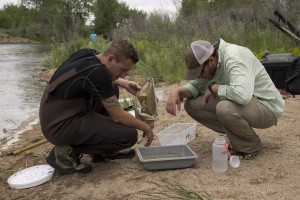
The program helps students learn hands on about water quality, biology, population studies, and environmental issues. "I really like having the tank in my classroom because it’s a new lesson every day," said Mike Sanchez, TIC teacher at Academy High School in the Maptleton School District. "There’s water chemistry, population dynamics, evolution, ecology, fish anatomy, etc. You can always come up with something to talk about and the kids are genuinely interested."
In 1997, TIC was started in New York through the efforts of the late Joan Stoliar, volunteers from Trout Unlimited and the Theodore Gordon Flyfishers. Since its inception, TIC in NY has grown from four classrooms to more than 200. This rapid growth is a testament to the program’s adaptability, effectiveness, and ability to interest students of all ages and backgrounds.
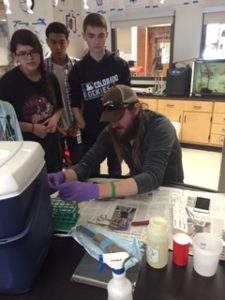 In Colorado, there are currently six active tanks involved with the TIC program. These classrooms are located all over Colorado. CTU helps these classrooms by assisting in obtaining trout eggs, coordinating supplies, and helping with the required disease testing prior to the release.
The trout fry are released into a local river, stream, or lake. This allows the kids to be connected and engage with their local environment and ecosystems. Some of the sites teach kids about fishing and how it relates to conservation and the fish they raised. "We also spend a few days enjoying some fishing at local ponds and the stocked Lake Lehow in Littleton," said Sanchez. "Kids appreciate the biology and learning how to fish, it’s a great week."
Sites are typically teamed up with a local chapter that will also help with some of the funding and supplying the classroom with the necessary equipment. This allows the chapter to connect with youth in the community and helps connect kids to their local ecosystems. "Trout in the Classroom helps our chapter engage local middle school students by connecting them to the habitats and ecosystems in their own backyard," said Ben Bloodworth, President of the Grand Valley Anglers. "The program allows students to learn hands-on about challenges facing trout populations and water quality unique to the western slope.”
 Parents have also gotten into the fun through TIC. "While the program is targeted at the kids, the teachers involved have noted that many of the parents have been excited about the tanks as well, not only keeping up with the egg/fry progress through their children, but visiting the tanks during parent-teacher conferences, involving the whole family in the educational process," said Bloodworth.
If you or someone you know may be interested in developing a Trout in the Classroom site at your school, please contact Jeff Florence, for more information!
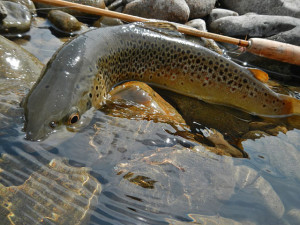 1. Use Yarn- many of you reading this may have heard this recommendation before, but it bears repeating. I feel that strongly about it. Simply put, yarn indicators are WAY more sensitive than plastic bobber-style indicators. Fish this time of year can be pretty lethargic (compared to summer) and typically won’t eat your flies with much aggression. Oftentimes your yarn won’t even dunk underwater but rather just ‘pause’ or ‘lean over’ when a fish strikes. If you’ve never used yarn indicators before, be prepared to be amazed with the sensitivity you’ll get. Side note- tips for yarn success- carry several and liberally apply some fly floatant before starting the day. Be prepared to dry off your indicator every couple hours and reapply. If you decide that your indicator is too waterlogged after a few hours, simply swap it out for a fresh one. While I realize these do require a little more maintenance than a thingamabobber, the fact that it leads to more fish in the net throughout the day is always worth it to me.
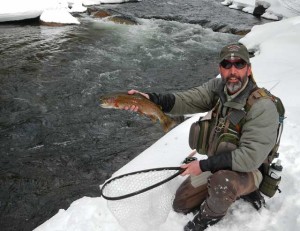 Whenever you approach a likely looking area, always make it a point to fish it while keeping your wading boots on dry ground. Avoiding splashing around, crunching rocks, and in general- disturbing the water with your steps- is always going to leave the fish feeling much more at ease and in turn- more eager to eat your flies (this rule should actually be applied year round).
 5. Watch the bubbles- we’ve already talked about indicators and weight, and I firmly believe that one of the biggest reasons people don’t catch as many fish as they should is that they’re simply not getting down to them. Next time your nymphing make sure to keep an eye on the bubbles on the surface. What are they doing? Are they moving the same speed as your indicator? If so, this is a dead giveaway you’re not getting down to the fish. Most fish this time of year are sitting very close to the bottom. The water on the bottom of the river is moving slower than the water on the surface. If you’re indicator is floating the same speed as the bubbles on the surface, this means that you’re not getting down to the fish. Simple as that. The goal is to always have your indicator floating SLOWER than the bubbles on the surface. This can quickly be achieved by adding a little more depth and/or weight to your rig. If you’ve never paid attention to this before I think you’ll be amazed at how much of a difference it makes and how quickly you are now able to dial in your rig, ultimately achieving a perfect drift to the fish!
 Why did you become a member and what chapter are you involved with?
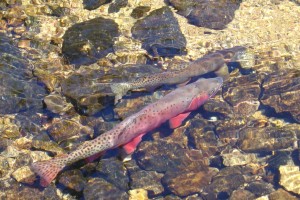
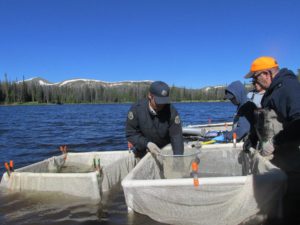 Colorado TU teamed up with Colorado Parks and Wildlife to reintroduce Greenback Cutthroat trout into their native watersheds all along the Front Range. Efforts this past year including spawning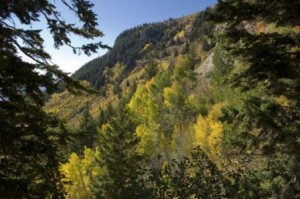
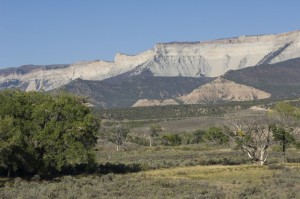 The MLP process is a new tool that promises to address some of that top-down, fragmented approach to public land management. To their credit, the BLM is listening and incorporating suggestions from local ranchers, conservation groups and elected officials into their leasing plan for South Park.
 The Roan Plateau is home to outstanding big game habitat and unique native trout like those pictured here. Trout Unlimited has been hard at work on the Roan for more than two decades, with many hundreds of volunteer hours invested by the Grand Valley Anglers chapter on habitat protection and improvement projects from instream structures to riparian fencing and replanting. TU also helped install a fish barrier to protect native cutthroat trout habitat being restored by Colorado Parks and Wildlife.
 The Thompson Divide (including Thompson Creek pictured here) makes up more than 220,000 acres of federal land in Pitkin, Garfield, Gunnison and Mesa counties and contains some of Colorado's most productive habitat for big game, cutthroat trout and numerous other native species. The area is used by more than 10,000 resident and nonresident big game hunters every year and serves as the headwaters to some of Colorado’s most popular fisheries including the Roaring Fork, North Fork of the Gunnison, and Crystal River.
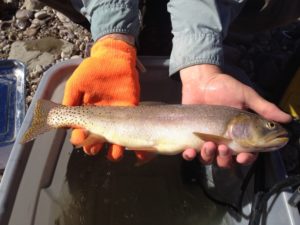
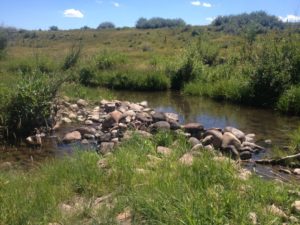 A small creek in southwest Wyoming just got a big upgrade. This November, a push-up style diversion was improved to a fish-friendly rock vane structure with a head-gate, reconnecting approximately 6 miles of habitat for the native Colorado River cutthroat trout that reside there. This project was unique in that it all began with the local school. Trout Unlimited partnered with the McKinnon Elementary School to study their home water, the Henry’s Fork River, through the Adopt-a-Trout program. This particular program involved tagging Colorado River cutthroat trout with telemetry tags and tracking their movement from 2014-2016. The students each got to “adopt” their own fish and follow it throughout the year. They learned a variety of river ecology lessons, including fish anatomy, macroinvertebrate identification, applying the scientific method, riparian ecosystems and many more. They also had to map where their fish moved using Google Earth.
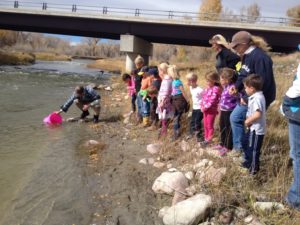 Using two years of the Adopt-a-Trout data and an instream flow study that TU conducted on Beaver Creek, a major tributary, we discovered that there was a push-up dam near the confluence to the Henry’s Fork that was not allowing fish passage for a critical part of the year. None of the students’ fish were able to pass that point during the summer months. So, TU collaborated with the Lonetree Ranch to develop a fish-friendly diversion that would still allow them to receive their irrigation water, but would allow for fish passage during low flows. A head-gate was also installed so that they could turn the ditch off when they no longer needed to irrigate, leaving more water instream for the trout. Thanks to the funding provided by the Wyoming Landscape Conservation Initiative, the Wyoming Wildlife Natural Resource Trust and the Natural Resources Conservation Service, the project was able to be completed November 2016.
 This is just the first of many projects that will be done along Beaver Creek to benefit native trout. Over the next year, the McKinnon students will be assisting with vegetation planting and monitoring on several sections right above the diversion to provide better cover and reduce stream temperatures during the summer months. Projects like these are not only reconnecting populations of native trout, but reconnecting kids to “their” fish and river.