TU and Newmont Mining partner on mine cleanups

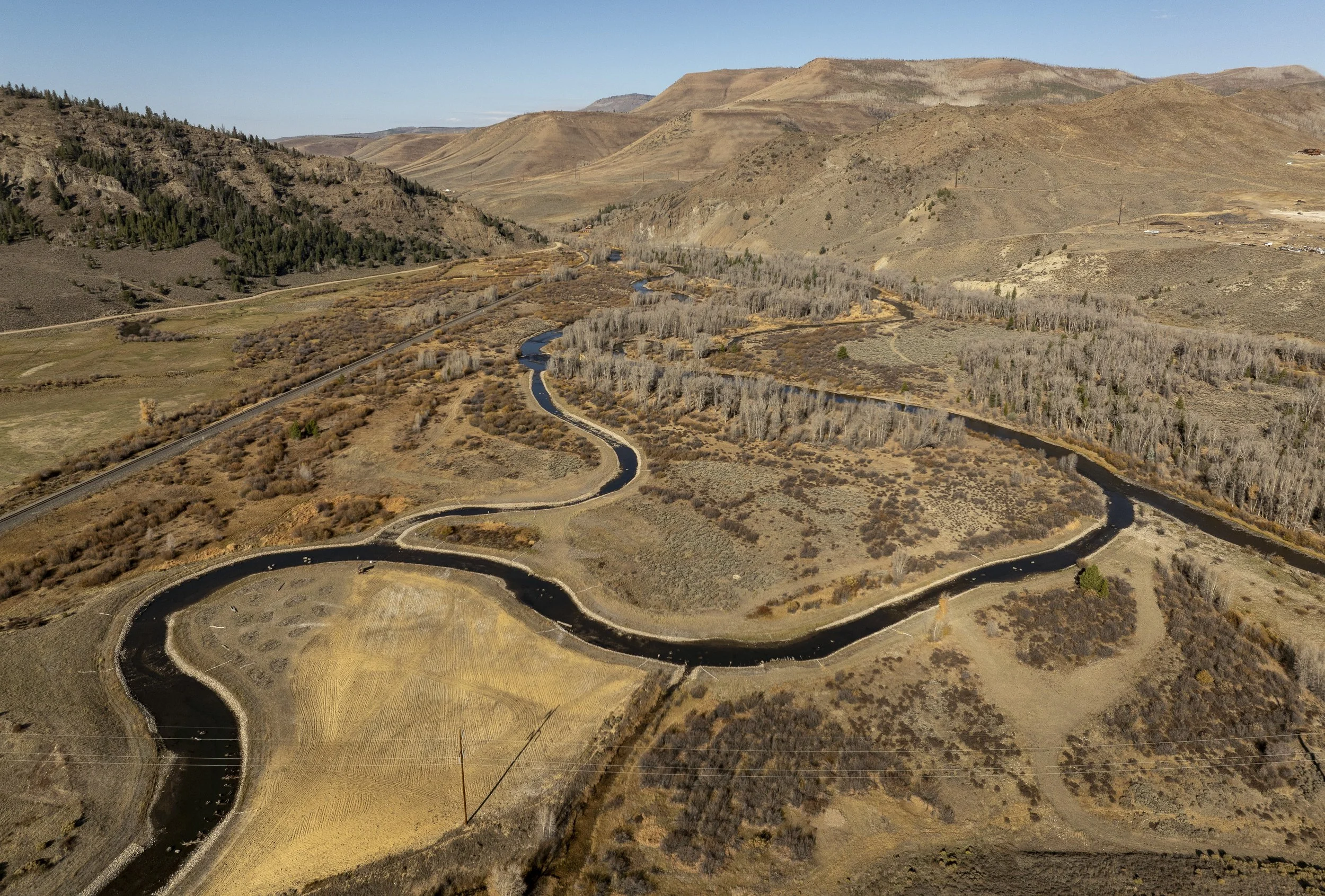
By Elizabeth Russell Trout Unlimited is excited to announce Newmont Mining Corporation as a new and vital supporter of our Colorado Abandoned Mine Restoration Program. These historic mines and their legacy of toxic sediments and draining tunnels pose one of the most widespread—yet least addressed—threats to Western rivers and watersheds. By most estimates, more than 500,000 abandoned mines pollute 40 percent of headwater streams in the Western United States, and degrade over 14,000 miles of trout and salmon habitat.
Penn Mine from E RussellThe estimated costs to clean up these sites range from $32-72 billion. Trout Unlimited initiated our Western Abandoned Hard Rock Mine Restoration Program in 2004 to both clean up problem mine sites that impact streams and fisheries, and to draw attention to the challenges associated with these efforts.  From our innovative mine tailings revegetation projects addressing toxic mine tailings in Colorado to our successful floodplain restoration projects in Montana, Trout Unlimited has earned national recognition as the leading practitioner of Good Samaritan abandoned mine restoration in the country.

In Colorado, the problem of leaching mines is particularly prevalent and threatens the state’s most iconic rivers. The issue of water pollution stemming from abandoned mines burst into public consciousness when 3 million gallons of polluted heavy metal-laden water spilled into the Animas River from the Gold King Mine near Silverton, Colorado, in 2015. Although this spill was large-scale and devastating, thousands of similar mines leak that same orange polluted water in smaller amounts every minute of every day.  Without cleanup action at each site, this will continue forever.

That’s where Trout Unlimited comes in.  Our Colorado Abandoned Mine Restoration Program tackles cleanups by removing polluted waste and tailings from riparian areas, revegetating and stabilizing streambanks and natural stream channels, creating fish habitat, and improving water quality.

We are stopping the toxic legacy one watershed or river at a time.

It’s encouraging that some mining companies are stepping up to help address this problem. Newmont Mining Corporation is one of the largest mining companies in the world and owns the Cripple Creek and Victor Mine in Colorado.

Newmont has worked previously with Trout Unlimited and state and federal agencies to improve habitat for Lahontan Cutthroat Trout (LCT) in Nevada’s Maggie Creek basin. Changes in livestock grazing practices and other improvements in the Maggie Creek watershed have dramatically boosted stream and riparian habitat health throughout the basin, benefiting LCT populations.

“Newmont has recently expanded our North American operations into Colorado with the acquisition of the Cripple Creek and Victor mine,” said Newmont executive Steve Skidmore. “We look forward to our continued habitat restoration efforts in cooperation with Trout Unlimited in Colorado watersheds.”

Newmont Mining Corporation joins Freeport-McMoRan Inc., which owns the Henderson and Climax mines in the state, in supporting our program to improve water quality and fisheries in mining-impacted watersheds in Colorado. Giving back to the communities in which these companies operate is an important part of their commitment to the environment.

For TU, their support provides the critical funding needed to support our staff and project work.  We look forward to showcasing our excellent cleanup projects in the near future.

Elizabeth Russell is manager of TU’s Colorado Abandoned Mine Restoration Program. 

Greenbacks Spawning at Zimmerman Lake

by Colton Gully

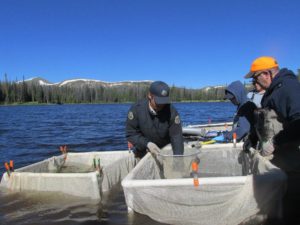
As the Colorado Parks and Wildlife (CPW) black, Dodge Ram and green F-150 pulled up to our campsite early in the morning on Wednesday July 6, 2016, the damp cold of early morning began to fade. Volunteers from the Denver area- Darian and Jack, CPW Biologists and their seasonal techs, along with staff from CTU stepped out of the trucks to be greeted by members of the Cheyenne Mountain Chapter of Colorado Trout Unlimited Bob, Rick and I. Boyd Wright, leading biologist on the team, greeted us kindly as he put on his waders, his colleagues did the same. As we made our way down to the lake we talked niceties but once we reached a gray tarp marked “CPW” the business began.ColtonG-1.1

Boyd took time to brief the group on the objectives of the day. The main goal was to extract as many eggs as possible from the trapped greenbacks and fertilize them with milt so they could be taken to the Mt. Shavano Hatchery to be reared. In the process we would take samples of ovarian fluids, a pinkish soup that discharges with the eggs, to test for a virus dubbed VHS.

We broke from the brief. Seasonal techs ran to fill five gallon buckets of cold, clean water to be used for temporary holding of fish, volunteers Darian and Jack hopped in a boat with head of Native Aquatics at CPW Harry Crockett to retrieve traps filled with greenbacks.

ColtonG-1.0

The trap consists of a curtain like net suspended vertically in the water column by buoys. The curtain reaches out from the bank to the center of the lake perpendicular to the shore. Cruising greenbacks, on their way to spawn, stumble upon the curtain, follow it towards the center of the lake, and enter a series of diminishing cylindrical mesh barrels that when entered fully do not allow the fish to swim out. The night before CPW techs set up two nets on opposite sides of the lake.

ColtonG-1.2


Both traps were filled with greenbacks. Because this was a spawning day, not just a catch and count day, the greenbacks were sorted by sex, year class and cross types. Fish put into Zimmerman in 2014 were born in a hatchery in 2013, as follows fish stocked in 2015 were born in 2014. All greenbacks, before they are stocked have a PIT tag inserted into their gut and a VI tag attached behind their gill plate almost like an earring. The VI chip indicates the age of the trout and its cross type. Different colors correspond to one of three cross types, WildXWild, HatcheryXWild, HatcherXHatchery. These crosses, along with data gathered from testing ovarian fluid, factor into research being done to quantify the fitness of greenback cutthroat trout by CPW Biologist Kevin Rodgers. Once quantified the data will be used, among other things, to bring about increased genetic diversity through improved spawning methods.

The commotion that came with sorting fish was scientific to say the least. Boyd and his fellow biologists stood waist deep in the lake around a submerged contraption built out of rebar and mesh laundry baskets. Each basket was marked as male or female, year class, and assigned one of the three cross types. As they sorted fish into the appropriate laundry basket they called out the color of the VI tag, year of birth, and weather the fish was ripe, ready to spawn, or not. The rapidity of the shouting was mind numbing. I thought “who could possibly be taking all of that down so fast?” Nobody but seasonal tech Ace Riverman. He recorded accurately and precisely all fish captured. Later Boyd would joke “Always good to have an Ace in the hole”.

Once all trout were recorded it was time to spawn them out. Greenbacks were methodically removed from the laundry baskets, males by cross type, females at random, and placed in the five gallon holding buckets mentioned earlier.

Love filled the air as eggs started spilling out of ripe females. The tiny, salmon colored orbs came out the consistency of tapioca. Once the ovarian fluid was drained off of the eggs and captured, milt was squeezed onto the eggs out of two different males and the bowls were handed from fish handler to decontaminators. Once the eggs were clean they were transferred to coolers filled with a dilute iodine solution that kills bacteria and viruses but does not affect the health of the eggs. After 30 minutes the iodine solution was decanted and replaced with cold clean water. The egg coolers were then individually labeled and transferred to a larger cooler destined for Mt. Shavano Fish Hatchery.

Spawning all of the fish, from capture to cooler, took about 3 hours. Clean up followed the science and time to talk followed cleanup. The team of CPW biologists lead by Boyd Wright are a riot. Boyd’s smile is charged with youth and he radiates the excitement of a young father. The atmosphere he and his team create is infectious. They invite intrigue, sponsor team work and they laugh a lot. Their excitement stems from a genuine passion for the species that make our state unique; their hospitality can only come from a deep connection to the people strive to keep it that way.

ColtonG-1.3

Throughout the day we volunteers were included in key aspects of the event. From brining in traps to decanting eggs, the willingness of CPW to include volunteers in their work made us feel needed and appreciated. Not only did we feel good, our help was visibly quantifiable. Without us the spawning may have taken 3/4’s of the day instead of a couple of hours. This including the fruits of our labor, over 15,000 fertilized eggs, made the early morning commute worth every hour of missed sleep.


We Kept Our Fish Cool

Thanks to the great work by Trout Unlimited, partners, and members and supporters throughout the state, the Colorado Water Quality Control Commission (WQCC) rejected the proposed temperature standards from the Water Quality Control Division (WQCD). These changes would have allowed higher elevation streams to reach 63 degrees- 3 degrees over the chronic limit for sensitive coldwater species. For middle elevation streams (the most common streams), the limit would have been raised to 65 degrees, just about the chronic limit for most trout species in Colorado.

The potentially higher temperature standards would have also occurred during the months of April to November- the months of Rainbow and Brown spawning seasons when the fish are more sensitive and susceptible to changes in their environment.

But our fish can chill out.

13315500_10153661389139067_6247084672571810423_nGroups all over the state worked together to protect our state's water quality and our trout's quality of life. CTU hired water quality expert, Ashley Rust, as a consultant to provide technical support. Her work demonstrated flaws in the data selection and analysis used for the WQCD’s proposal. TU also worked with Colorado Parks and Wildlife scientists along with other organizations including Sierra Club, Colorado Wildlife Federation, CPW and EPA.
Typical allies of the Division also helped in the rebuttal of the proposed changes. "I heard a Commissioner express concern with the fact that so many of the Division's traditional allies joined as parties to oppose the Division," said Mely Whiting, TU Counsel. "I don't recall the last time so many organizations participated in a Commission hearing. It makes a huge difference!"

The members of CTU also stepped up big time and sent over 200 emails to the Commission stating their argument against the changes. Along with chapter presidents signing a letter to the commission, members helped collect data through a citizen science campaign as well as offered their own testimonies to the issue from various vantage points.

Waist deep"Big thanks to John Woodling, who's testimony was a turning point in the hearing," said Whiting. "To Robin (Knox) who in 5 minutes conveyed a lifetime of experience- I loved the example of all the poor fish huddling in a small pool in the Yampa to avoid the hot water in response to the Division's callous assertion that if it's too hot, fish can just swim away. Big thanks to Dennis Buechler, who very softly and meekly brought in the impacts of these decisions on small businesses."

But the fight for our trout and water quality isn't over yet. The Division will most likely come back next year with changes along the same principal but on a basin-by-basin standard as opposed to the statewide changes proposed this year.

However, with the great work done by TU, partners, and the members throughout the state, we will all be ready to defend Colorado's trout and water moving forward.


Congrats to Our Summer Raffle Winner

Marty Jones was the winner of our Summer Raffle featuring three great fishing trips for two anglers- a float trip on the Arkansas, a float down the Colorado, and a walk/wade trip on the Upper Gunnison. A very big thank you goes to everyone who purchased tickets and to the outfitters who donated these great trips! We appreciate your continued support!

Arkansas River float trip:  a full day float for two on one of Colorado's newest Gold Medal waters, the Arkansas River.  This trip with Dvorak Expeditions will take you through one of Colorado's most-loved brown trout fisheries, and includes lunch and beverage.  Dvorak was Colorado's first licensed outfitter and is well known for his outstanding fishing and rafting trips on the Arkansas, Gunnison, Colorado and other regional rivers.  Learn more at the Dvorak Expeditions website.

Colorado River float trip:  a full day float trip for two on the "lower Upper" Colorado River, above Dotsero.  This float trip is with Jack Bombardier and Confluence Casting, who lives alongside the river and loves to share his "home waters" with new and returning visitors. Jack will take you on the Colorado River as it flows through one of the most colorful and beautiful canyons anywhere. On a typical float you might see bighorn sheep, eagles, dinosaur tracks, waterfalls and course lots of feisty trout. Best of all, since this section sees very little river traffic,there a good chance you 'll have it to yourselves!  Learn more at the Confluence Casting website.


Upper Gunnison River walk/wade trip:  a full day walk/wade trip for two on public water in the upper Gunnison basin, operating from Three Rivers Resort in Almont with Willowfly Anglers, in the heart of one of Colorado's great fishing meccas picking up world-class angling options with the Gunnison, East, and Taylor Rivers.  Operating for over 30 years, Willowfly offers experienced fly fishing guides, excellent private water options (available for an additional fee), as well as a full service fly fishing shop. Willowfly Anglers is the only Orvis Endorsed Outfitter in the Almont area and was recently named one of the top five Orvis Endorsed Outfitters in North America.  Learn more at the Three Rivers Resort website.

Farewell to a River Champion

By: Ken Neubecker, Northwest Regional Vice President The rivers of Colorado lost a good friend a couple weeks ago.  Steve Glazer wasn’t a fisherman, in fact he wasn’t much of an athlete in any sense.  But he was passionate about the rivers and streams, and the water of Colorado.  He was, as I am, self-taught in the issues surrounding the water and rivers of Colorado.  As with many of us his passion and knowledge grew out of concern for his home streams; Coal Creek, the Slate River and the upper Gunnison.

Crested Butte was his home for 47 years.  He brought cable TV and a bank to town.  He saved the Princess Theater from destruction, re-opening it as a central part of that small community in the ‘70’s, bringing the magic of cinema to what was then a pretty isolated mountain town.  When a massive molybdenum mine was proposed on Mt. Emmons, the “Red Lady”, above town Steve was one of the first to close ranks in opposition.  He did the same when a massive new reservoir and trans-mountain diversion was proposed for the headwaters of the Taylor River at Union Park.

Steve first became involved with rivers through a concern for what was happening to water quality.  The mining heritage of Colorado may be a point of historical pride, but the damaged and degraded rivers are the lasting legacy.  Steve wasn’t a trained scientist, lawyer or otherwise educated as an environmental “professional”.  He learned what he needed to know through  patience, listening, reading and asking lots of questions.  He paid attention.  He went to meetings of the Water Quality Control Commission for years before he felt well enough versed in the subject to speak out.  But when he did speak it always caught people’s attention.  Steve was no shrinking violet, never afraid to speak his mind or ask probing questions. If he disagreed with Commissioners, staff, politicians or other “experts” he would say so, publicly.  Steve could be counted on to say what needed to be said.

Yet he was always respectful of everyone, even those with whom he disagreed the most.  He was always quick with a smile, a handshake and gratitude for being able to do and say what he did.

In the end this “hippie” from back East who rolled into Crested Butte back in 1969 and  became one of the most highly regarded and well liked water “experts” in Colorado. State officials, ranchers, business leaders and his colleagues all came to admire and respect his thoughtful understanding of the issues.  And that wasn’t just in Colorado.  For many years he was the Sierra Club’s main man for the Colorado River, from top to bottom.  And he could be counted on to be a contrarian here as well.  Being from the rural West Slope of Colorado he had a better understanding of how rivers and water is used, as a vital part of the west, than many of his more urban contemporaries.

One of the roles and jobs for which he was proudest was on the Board of the Upper Gunnison River Water Conservancy District, not exactly an “environmental” organization.  But he succeeded in bringing an environmental voice into the conversation of traditional water use at a time when tensions were high and trust levels low.  His grace, knowledge, respect and understanding helped bridge that divide.  That is a legacy from Steve that we all benefit from.

Steve was a good friend, and I miss him greatly.  Rarely have I worked with someone with the skill, knowledge and integrity he had.  Steve was a friend of Colorado’s rivers and streams and while most people in Trout Unlimited never knew him or his work, we are all deeply in his debt.


Trout Unlimited praises river benefits, cooperation on Moffat Project

Colorado Gov. John Hickenlooper today officially endorsed Denver Water’s proposed Gross Reservoir Expansion Project, also called the Moffat Collection System Project, calling it a model for how to achieve a secure water supply “while assuring a net environmental benefit in a new era of cooperation.”    The governor’s endorsement follows the Colorado Department of Public Health and Environment’s June 23 release of aSection 401 Water Quality Certification that finds the proposed project meets state water quality standards. Trout Unlimited issued the following statements:

David Nickum, executive director, Colorado Trout Unlimited:

“Trout Unlimited supports this project, which strikes a necessary balance between the water needs of Front Range municipalities and the need to protect healthy flows and fish and wildlife habitat in the Fraser River. The so-called “Learning by Doing” program in the proposal sets up a collaborative process that requires water users to monitor the health of the river in coming years and adjust operations to address unforeseen challenges and opportunities. Moreover, Denver Water has entered into partnerships on the Front Range to ensure that the project alleviates chronic low-flow problems in South Boulder Creek. Both sides of the Divide benefit.”

Upper Colorado IMely Whiting, lead negotiator for Trout Unlimited:
“The fact is, the Fraser and Colorado River have been in decline for many years, and Learning by Doing is giving us a chance to change that trajectory by engaging the key stakeholders on how to work together to best manage the river.  While more water will be drawn from the river in wetter years and seasons, greater cooperation in managing water – including provisions that provide extra water during low flow periods, and investment of funds in restoration activities – means that we can put the Fraser and the Colorado on a pathway toward better river health.

“That’s the key challenge going forward—in an age of increasing water scarcity and pressures, how can we work together to make the best use of a finite resource while protecting Colorado’s outdoor quality of life?  As the governor said, the Moffat expansion project provides a model for how we can find that pragmatic common ground that secures our water future. Now we need to roll up our sleeves and do the actual work.”

Kirk Klancke, Colorado River Headwaters Chapter, Trout Unlimited:

“It’s important to me and others who live here and love this place to preserve its natural resources and outdoor opportunities—it’s what makes this valley such a special place to live and play.  I’m encouraged that the Moffat expansion project requires Denver Water and other stakeholders to ensure that the health of the Fraser River doesn’t deteriorate due to additional diversions.

“After years of conflict and lack of communication, we have a group of stakeholders, including Denver Water, Grand County and conservation groups like Trout Unlimited, committed to working together to find common ground and keep the Fraser River and its trout healthy. That’s a remarkable turnaround—and it’s huge progress.”

2016 Conservation and Fly Fishing Youth Camp

By: Ameen Hosain As fourteen youthful and enthusiastic campers showed up to the Barr N I ranch for this year’s fly fishing and conservation youth camp, it was easy to tell that the next five days would be a week to remember.

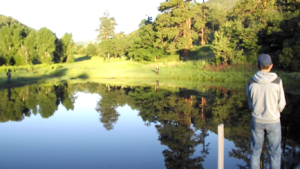
pretty lake and fisherWith many fish to be caught and much to be learned, the campers settled in to the barn that they would call home for the coming days. As the week progressed the campers gained experience in the worlds of conservation and fly fishing and made new connections with others who shared similar passions for the outdoors.
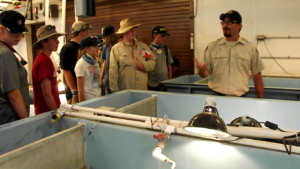
Through fishing instruction, and participation in activities such as a fish hatchery tour and a river restoration project, the young anglers learned the relationship between the fish they are able to catch and the conservation efforts of Colorado Trout Unlimited and other organizations. These experiences all combined to create a lasting impact on all those involved.

To kick off the week, campers took a drive to the city of Alamosa, where they took a tour of the Native Aquatic Species Hatchery, a facility based around the restoration of Colorado’s native fish.  Here, over ten thousand fish are being raised with the intention of stocking them into Colorado’s rivers in the future. Campers were exposed to the sciencecpw talking dude behind genetics, and were able to see what it takes to bring back a species from endangerment. Though the camp focuses on trout conservation, the hatchery harbors nothing but native species (meaning no trout), thus enabling campers to realize that conservation goes further than just the species most popular in Colorado rivers.
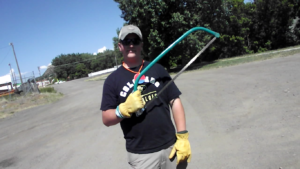
Another major part of the campers’ experience was their participation in a river saw kidrestoration project in collaboration with the Purgatoire River Anglers Chapter of CTU out of Trinidad. The Purgatoire River runs through Trinidad and has seen many restoration efforts in the past few years. Campers assisted in the removal of a fern called Russian olive- an invasive plant that consumes large amounts of water, taking it away from the river system.  A day was spent using tools and chainsaws to cut down many of these large plants to better the fishery that the anglers of Trinidad value greatly.
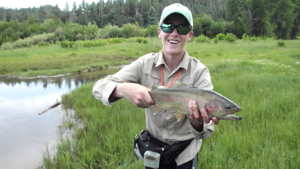
As the title presumes, the fly fishing and conservation youth camp also put aside much time for campers to hone their fishing skills on the numerous stock ponds the Bar N I ranch had to offer, as well as the beautiful creek and the larger lakes surrounding the property. Given large amounts of time to fish big fish kideach day, and instruction from experienced guides and fishermen, campers enjoyed testing newly tied flies on eager fish. Astoundingly, at the end of five days, every young angler, regardless of skill level was able to successfully land a fish, with dozens of healthy trout seeing the net.
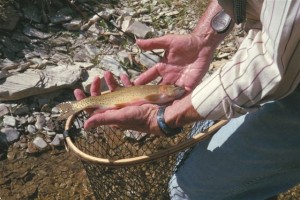
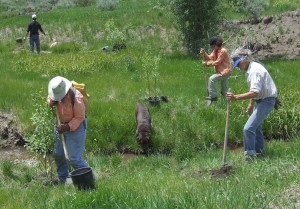
The 2016 camp was an extreme success and campers and volunteers alike went home with smiling faces. With the future of our wildlife habitats at stake, Colorado Trout Unlimited gave campers the building blocks to continue down a road of conservation, using the sport of fly fishing as a catalyst to light a fire in the hearts of young anglers.

With hopes that these fisherman will follow in the footsteps of those they learned from, Trout Unlimited’s fly fishing and conservation youth will continue to inspire young conservationists one year at a time, with no end in sight.

Colorado Trout Unlimited would also like to give a special thanks to its volunteers, and those that are able to make this camp a reality year after year, as much success is due to their efforts. CTU would also like to thank the chapters that sponsored a camper with a donation to the Youth Camp. Without all of your support this camp wouldn't have been possible!!

On the water bus in the Gunnison basin

By Cary Denison Collaboration in water conservation got a shot in the arm last week thanks to the Colorado Foundation for Water Education Gunnison Basin tour. A bus tour can sometimes be an exercise in uncomfortable conversations and car sickness. But the CFWE tour, which started and ended in Gunnison, proved to be a valuable vehicle for removing barriers between water stakeholders and encouraging them to create solutions through compromise and cooperation.

The day and a half long tour introduced participants, who ranged from interested citizenry to the most serious of water wonks, to the natural water wonders and innovative water infrastructure that keeps the fields green, the rivers flowing and the Gunnison Basin breathtaking.

Each tour stop brought a new twist on how agricultural water uses are addressing their unique water supply needs in ways that reduce the impact on other water users and the environment. Trout Unlimited has been partnering on many of these collaborative projects because better management of water means healthier flows for river recreation and trout habitat.

The tour showed that modernizing water systems on the ranch or farm has the potential to make our farms and rivers more sustainable and healthy in the face of drought, rising temperatures and other pressures threatening the larger Colorado River Basin.

Randy Meaker, a farmer near Montrose, welcomed the group and displayed a “big-gun” irrigation system that allows him to more efficiently irrigate his feed crops. Nearby in Olathe, farmer David Harold demonstrated a drip system he is installing on a field that is currently included in the System Conservation Pilot Project, a program that will compensate him and other Colorado River Basin users for conserved water. At a brief stop at Rogers Mesa Fruits, the group heard from local conservancy district president, Tom Alvey, about a new Stream Management Plan sponsored by the district, TU and local conservation groups that will help all water users plan for a more secure water future.  Near Hotchkiss we heard from farmer Tom Kay, who explained how using technology like soil moisture sensors and automated sprinklers are helping him grow crops with less water delivered. Tom   told us that market-based approaches to water sharing could work as a water conservation tool that protects and compensates farmers. On the road to the small town of Crawford, we heard from Patrice Alonzo, water manager, who discussed how funds provided by the NRCS through partnerships with Trout Unlimited and others will be used to improve irrigation infrastructure, resulting in water savings.

On the second day of the tour we visited Jesse Kruthaupt, TU’s Gunnison Basin Project Specialist, on his family’s ranch on Tomichi Creek, where he explained how they are using a creative lease from the CWCB Instream Flow program to address periods of low flow and compensate for production losses. We wrapped up the tour with a visit to the Trampe Ranch north of Gunnison. Here Bill Trampe and Perry Cabot from the CSU Water Center described how flood irrigation works and how they and partners, including Trout Unlimited, are working toward improving irrigation practices in a manner that works for the producers and conserves water.

And in case you haven’t noticed yet, Trout Unlimited is helping coordinate resources and funding for many of these projects in the Basin.

While it is unlikely that any tour participant went home with a silver-bullet solution for our complex water issues in the Gunnison Basin, it’s safe to say they went home with a better understanding of the water challenges we face—and likely a sense that Trout Unlimited is going to be there to help craft the solutions.

Cary Denison is Gunnison Basin Coordinator for Trout Unlimited. 

CTU Praises Final Roan EIS

On June 28, the Bureau of Land Management released its Final Supplemental Environmental Impact Statement for the Roan Plateau, a backcountry area prized as a fish and wildlife oasis and a cornerstone of the area’s recreation-based economy. While TU said it was still reviewing the document, the BLM plan appears to cancel the majority of oil and gas leases on top of the Roan Plateau, including all of those in the Trapper and Northwater Creek watersheds, areas that encompass the best cutthroat trout habitat on the Roan. The East Fork of Parachute Creek headwaters, recently reclaimed and restored for native cutthroat trout, would also remain undeveloped with leases canceled. The BLM’s proposed decision reflects the 2014 settlement reached between Bill Barrett Corporation—the lease holder—and conservation groups.

“This is another big step forward in years-long efforts to protect one of Colorado’s natural treasures,” said David Nickum, executive director of Colorado Trout Unlimited. “It shows that, working together, we can craft a management solution that provides lasting protections for the Roan’s most valuable fish and wildlife habitat, while allowing careful, responsible development of its energy reserves.”

The Roan is a Colorado last best place: its small streams hold rare populations of genetically pure Colorado River cutthroat trout—a species found in less than 10 percent of its historic range. Public lands on the plateau’s top and at its base provide key summer and winter range and migration corridors for large herds of mule deer and elk.

A Trapper Creek cutthroat

The surrounding landscape is also rich in energy resources and dotted with oil and gas development sites.

“Over the years, our members have invested thousands of dollars and many hundreds of volunteer hours into habitat and fisheries projects on the Roan,” said Ben Bloodworth, president of TU’s Grand Valley Anglers chapter. “It’s a very special place to Colorado sportsmen and women, and this BLM plan will help protect it for future generations to enjoy.”

The BLM release of the FEIS will be followed by a few more steps to secure final protections for the Roan. A 30-day public comment period for the Final Supplemental Environmental Impact Statement and proposed plan begins July 1. After the comment period, the BLM is expected to issue its final Record of Decision.

TU has a long history of involvement with the Roan, beyond being party to the lawsuit and subsequent settlement that set the stage for the BLM's new EIS and plan.  TU projects on the Roan have included extensive fencing and riparian plantings along Trapper Creek, Northwater Creek, and parts of the East Fork Parachute Creek watershed; installation of a fish barrier on the East Fork which isolated the upper portion of the stream from downstream brook trout and allowed Colorado Parks and Wildlife to re-establish native cutthroat trout there; and physical habitat improvements on Trapper Creek to provide improved low-water holding habitat. Grand Valley Anglers volunteers have been involved with project work in the area for more than 20 years.

TU volunteers planting willows along Trapper Creek

C-BT and the Colorado River

For over six million years, the Colorado River flowed from the Never Summer mountains in what is now Rocky Mountain National Park, to the sea of Cortez- cutting through over a vertical mile of a vast landscape while carving majestic canyons along the way. When the Ute and Arapaho tribes came to the Grand Lake area, near the headwaters of the Colorado River, they saw what was once a raging river. But through transmountain diversions, like Colorado- Big Thompson, the river seen by early inhabitants is not the same river it is today.

At the turn of the Century, when spring snow melt occurred, the waters of the Colorado would fill the banks and flood mountain valleys. While on the other side of the Continental Divide, farmers and ranchers along the plains were starving for water. In 1933, the Greeley Chamber of Commerce formed a committee to survey a transmountain diversion that would tap into the Colorado River headwaters near Grand Lake.

The groups lobbying for the diversion- named Colorado- Big Thompson (C-BT)- got their way in 1938 when Congress approved the project. And 19 years later in 1957, the project was completed. The C-BT was the biggest transmountain water diversion the state of Colorado has ever seen.

Lake GranbyThe water from the Upper Colorado flows from Lake Granby (which acts as the storage facility), then it is is pumped into Shadow Mountain Reservoir where it then flows down into Grand Lake. From Grand Lake, the water then is pumped through the 13.1 mile long Alva B. Adams Tunnel under the Continental Divide and flows into the Big Thompson River. From there, the water drops into power plants that supply the pumps on the western slope.
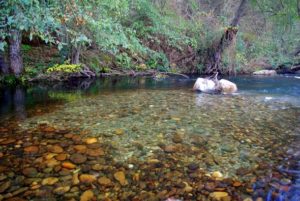
In it's first year, 230,000 acre feet were transferred across the divide annually. Since then, the  number of acre feet taken from the Upper Colorado is around 213,000 according to Northern Water. The tunnel can also contain flows of 550 cubic feet per second.

While the project is able to keep the eastern slope alive during drought years and helps support Colorado's agriculture economy, the Colorado River itself is harmed. In order to build the C-BT, Green Mountain reservoir needed to be constructed along the Blue River. This was built in order to store water that the C-BT took out of the Colorado.

However, there are about 34 miles of river between Lake Granby- where water is taken- and the Blue River confluence- where the water is returned. This leaves a "hole" in the river. Along this stretch, the river and it's fishery is slowing fading away.

Trout ReddAs the flows of the Upper Colorado are depleted by the diversion projects, the natural cleansing of the river fails to occur. Each spring, rivers experience flushing flows- an increase in water flow that breaks up sediment buildup along the stream bed. When the river isn't able to clean itself from sediment buildup between cobblestone, it doesn't allow for insects to hatch or fish to spawn.

Insects in the river hatch from the bottom of the cobblestone, but when the sediment concretes between the rocks, they aren't able to access the underside of the rock and hatch- leaving limited food sources for the trout in the water. The trout also needs the rocks to spawn as they turn rocks over to create their redds, which can't be done when sediment cements the rocks in place.

Under Senate Document 80- the document approving the C-BT and requiring the construction of Green Mountain reservoir- the document also states that the project needs, "to preserve the fishing and recreational facilities and the scenic attractions of Grand Lake, the Colorado River, and the Rocky Mountain National Park."

TU-CO-20100912-0189The West needed water to expand. Currently, 80 percent of Colorado's population is on the east of the Divide while 80 percent of the water is on the west side. This means that in order to thrive, water needed to be diverted. The C-BT opened the door to other transmountain diversions- including the Moffat Tunnel from the Fraser River, another tributary of the Upper Colorado headwaters.
While these diversions help the east slope, they are hurting the river. Through collaboration work among TU and water suppliers with hemp from very passionate individuals, we are working together to bring the river back to health.

The river will never be what is once was when the Ute and Arapaho tribes hunted and fished along its shores, but the river can return to a health that is good for people, insects and trout alike.