Still looking for water

Check out the newest Fraser video! Denver Water is taking more than 60 percent of the annual flows of the Fraser River--and the low flows are threatening prized fish and wildlife habitat on this tributary of the Upper Colorado. Our Homeless Trout is still looking for water in all the wrong places--go to www.defendthecolorado.org and tell Denver Water to leave a little H20 for the fish!


Colorado Outdoor Mentors program kicks off

Last weekend marked the official kick off of the Colorado Outdoor Mentors Program.  On Saturday September 28, several organizations came together for an outdoor skills festival at Barr Lake State Park. With the help of Colorado Parks and Wildlife, Pheasants Forever, Environmental Learning for Kids, the Rocky Mountain Bird Observatory, the Wildlife Experience, the American Canoe Association, and CTU over 200 people had the chance to try their hand at a wealth of outdoor activities and learn about native wildlife. Spearheaded by CTU, this Colorado Outdoor Mentors Initiative seeks to assemble a cohesive coalition of conservation organizations, state agencies, youth development organizations, and other key outdoor recreation stakeholders in Colorado to focus efforts on providing outdoor education to non-traditional audiences. By partnering with youth mentoring organizations such as Big Brothers Big Sisters and Denver Kids Inc., we can give more children the chance to learn how to fish, hunt, shoot, camp, and experience Colorado’s great outdoors.

Geocaching with The Wildlife Experience

Continuing participation for children who are exposed to outdoor opportunities often depends upon having a trusted adult who can share in those activities.  By partnering with mentoring organizations, the Outdoor Mentors program will help jointly expose youth and their adult mentors to hunting, fishing, and outdoor recreation – planting the seeds for mentors and youth alike to continue to experience the outdoors together.  By encouraging mentors to share their enjoyment of the outdoors with a child on a regular basis we can make a significant impact on that child’s perception of the outdoors. Also, it is our experience that many youth who participate in outdoor education programs represent a self-selected population from families who already hunt, fish, and engage in outdoor activities. By partnering with youth development organizations we can reach a population that have never caught a fish, shot a bow, or been in a canoe.

This program follows a successful model set forth by Pass it On Outdoor Mentors in Kansas. Pass it On Outdoor Mentors began as a program of Kansas Big Brother Big Sisters in 2002 and focused on recruiting members to spend time outdoors with a child. In 2006, the program spun off into a separate 501(c)3 with the goal of providing support to other youth mentoring organizations throughout the country. Today 20% of community-based matches for Kansas Big Brothers Big Sisters participate in Outdoor Mentors programming.  In  2011, the Western Association of Fish and Wildlife Agencies Directors unanimously endorsed the Pass it On Outdoor Mentors model as one that “would greatly expand the ability of state fish and wildlife agencies to engage in  more and new recruitment and retention activities by leveraging capacities of multiple stakeholder groups.”  A recent study by Responsive Management of 37 hunter and angler recruitment and retention programs highlighted one of the great accomplishments of Pass it On Outdoor Mentors. The study showed that 43% of participants in their programs come from families that do not hunt, shoot, or fish – they are reaching the kids who need to be reached.   With the second highest rate being 20%, no other program in the study came close to these results.  It is our goal to replicate the successes of this program in Colorado.

If you are interested in getting involved with this initiative, or better yet, mentoring a youth in the outdoors, please contact Jake Lemon, CTU Youth Education Coordinator, at jake.lemon@coloradotu.org or 720-354-2646.

A balanced approach to wind and solar energy development on public lands

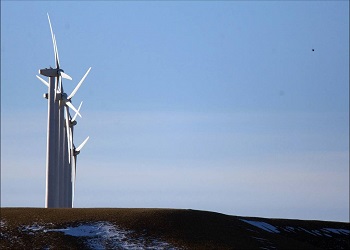
As commercial-scale wind and solar projects become an increasing presence on our public lands, sportsmen, state and county governments are stepping up to support the Public Lands Renewable Energy Development Act (Senate Bill 279 and House Resolution 596) that have been introduced in U.S. Congress.  These renewable energy projects take up large chunks of land for long periods of time, and may cause some unavoidable impacts on fish, wildlife and water resources and recreational access. The Public Lands Renewable Energy Development Act offers a way to offset unavoidable impacts by creating a conservation fund derived from royalties and other revenues generated by public land wind and solar energy projects. SB 279 would establish a formula for the distribution of wind and solar lease revenue where:

-25% would go to the state where projects are sited;  -25% would go to the counties where projects are sited;  -15% would fund the Interior Department to process wind and solar lease applications; -35% would be deposited in a fund for fish, wildlife, and land conservation. -Under H.R. 596, 25% of revenues would be deposited in the conservation fund, and 10% would be put toward deficit reduction.

Another important component of the Public Lands Renewable Energy Development Act isWindEnergyBMeulengracht that it can lead to a better framework for the federal agencies managing wind and solar on public lands. Right now land managers are using rights-of-way and special use permits—tools better suited to permitting irrigation ditches or cell phone towers than large-scale energy projects.  SB 279/ HR 596 are needed to provide specific direction for how best to administer wind and solar energy projects on public lands.

Specifically, these bills:

• Create a pilot program to determine whether and how to transition to a leasing program for public land wind and solar projects. • Establish a royalty fee for public land wind and solar projects • Outline a clear process for current and pending projects to transition to a leasing system

In Colorado, the bills continue to garner support and are currently supported by TU, CTU, the National Wildlife Federation, the San Luis Valley chapter of TU, Montezuma County, Clear Creek County, the San Luis Valley County Commissioner’s Association.  Additionally, the Western Governors’ Association supports the leasing and royalty concept in the Bills.

Colorado congressional representatives also support the legislation with Senators Udall and Bennet cosponsoring S279, and Representatives Coffman, Degette, Gardner, Perlmutter, Polis, and Tipton signing on as co-sponsors in the House.  Please thank them for their support should you have the chance during a district meeting with them.

Should you need more information on either of these bills or want to add your name in support of the Public Lands Renewable Energy Development Act, please contact Bob Meulengracht at 303-514-8227 or rmeulengracht @tu.org.

Farewell to a Legend

Last month, we lost one of the great leaders in trout conservation as Robert J. Behnke, Ph.D., passed away on September 13th at the age of 83.  Dr. Behnke was a professor emeritus of Fisheries Conservation and Wildlife Biology at Colorado State University.  During his illustrious career, he authored more than 100 articles and papers regarding fish and fisheries; helped re-discover two subspecies of native trout previously believed extinct (Pyramid Lake strain Lahontan cutthroat, and Colorado’s state fish the Greenback cutthroat trout); and brought fisheries science to decades of TROUT magazine readers through his “About Trout” column. Dr. Behnke was an unforgettable and outspoken voice for trout conservation, from supporting hatchery reform in California to promoting native trout restoration throughout western North America.  He inspired countless anglers and conservationists to value the beauty and uniqueness of native trout – and his years of work in translating the intricacies of fisheries science for a mass audience led Colorado TU to recognize him with its 2002 Trout Communications Award following the publication of his magnum opus, Trout and Salmon of North America.  Beyond his numerous publications and many personal achievements, perhaps his greatest legacy may be seen through the work of the generations of fish biologists who he influenced while serving on faculty at Colorado State University.

Dr. Behnke once wrote on his life’s research work by reflecting that his “career covers the period of the transition from the strictly anthropocentric, utilitarian based management of natural resources to a more ecocentric, holistic ecosystem form of management based on Aldo Leopold's land ethic. My work and publications over a 40 year period reflect this transition.”

His work as a researcher and educator will be carried forward by his own TU chapter, the Rocky Mountain Flycasters, through its Robert J. Behnke Fellowship. Dr. Behnke contributed the original endowment for this annual award, which supports the research of Colorado State University graduate students in coldwater fisheries research.  Before his death, he asked that in lieu of flowers, contributions in his memory be made to this fellowship.  You can contribute using the Rocky Mountain Flycasters’ convenient online donation page or by sending donations for the Robert J. Behnke Fellowship to the Department of Fish and Wildlife and Conservation Biology at CSU Foundation , PO Box 1870, Fort Collins, CO 80522.

Read more about Dr Behnke in the Ft Collins' Coloradoan.

Share your memories of Dr Behnke and read those of others here.

Listen to Dr Behnke’s reflections on “a life with trout” on a Midcurrent podcast.

Support the Robert J. Behnke Fellowship.

Statement from Trout Unlimited on the Shutdown of the Federal Government

Trout Unlimited is disappointed by the federal government shutdown because it undercuts fall fishing opportunities that are economically vital to communities bordering national parks and monuments. The shutdown also threatens to hamstring vital conservation efforts nationwide. For the first time in 17 years, our federal agency partners are not allowed to go to work with us, and the gates leading to some of the world’s best fisheries are locked. Trout Unlimited strongly urges Congress to restore government funding as soon as possible. Adverse impacts to TU are immediate. Many of TU’s science and restoration experts are prepared to attend this week’s Wild Trout Symposium in Yellowstone National Park, which is almost certain to be cancelled because the park is closed. Going on its 40th year, the symposium is a conference held every three years to bring together the best international experts on wild trout science and restoration techniques. This event is just the kind of activity that makes federal, state and local agencies, as well as their non-profit partners, more efficient at investing public and private resources in science and restoration. Thousands of dollars are lost, as are opportunities to improve trout conservation and make fishing better all across America.

Incredible fisheries will be off limits due to the closure of national parks, national wildlife refuges, and other federal facilities, at a time when they are most productive for anglers. Thousands of anglers were hoping to finish their fishing season chasing brown trout on Yellowstone’s famed Firehole River or cutthroats in the scenic Lamar Valley. Others were setting out to pursue the brightly colored brook trout of Shenandoah and Great Smoky Mountain national parks.  Many of these anglers have campsites reserved, flights booked and hotels reserved that revolve around access to these national parks.  Lands owned by the Forest Service and Bureau of Land Management will see many campgrounds closed, even barred shut when possible. To those planning on visiting these areas, and to the communities that depend on the tourism dollars anglers generate, Congress’ inability to act is ruining vacations and literally taking money from merchants at a time when it’s needed most.

In Colorado’s Front Range communities, TU is coordinating with federal partners to help recover from severe flooding. While emergency personnel are still on the job, many of those federal partners have been forced to stop working during a critical time for affected Coloradans.

TU’s 150,000 members and volunteers, who selflessly donate almost 700,000 hours to conservation every year, understand that getting trout and salmon streams protected, reconnected and restored requires working together with partners and allowing common sense to prevail. As we cooperate with local, state and federal governments, landowners and industry representatives every day, we hope that Congress can do likewise and restore funding for these vital operations.  This government shutdown is a stark reminder that our nations parks and monuments have a very real economic value to Americans from coast to coast, and that the government’s role in managing those lands on behalf of all Americans cannot be underestimated. TU hopes this reminder will spur Congress to act and provide the funding to sustain the traditions treasured by the nearly 40 million Americans who hunt and fish.

---Steve Moyer, Vice President for Government Affairs Trout Unlimited


Volunteers working to make Armstrong Creek more livable for a dwindling species of trout

Steamboat Today The creek restoration project is being spearheaded by Trout Unlimited, a national conservation organization, along with the Forest Service and Parks and Wildlife.

Brian Hodge, Trout Unlimited’s project coordinator for Northwest Colorado, said restoring Armstrong Creek isn’t just about helping out the fish.

“This has a number of other benefits,” he said.

He said decades of different land uses in California Park have fragmented the streams in the upper Elkhead Creek watershed.

Because of this, the creeks also are delivering more sediment to Elkhead Reservoir.

Improving the creek should reverse that trend.

Read more...

TU stands ready to help Colorado recover from disaster

All of us in the Trout Unlimited family are concerned about the Coloradoans who have been impacted by the catastrophic flooding.  As I write this, hundreds are still unaccounted for, and the extent of the massive damage is not fully known. What we do know is that over 10,000 TU members in Colorado—many of them living on the Front Range which has borne the brunt of these impacts—stand ready to assist the most-affected individuals, families and communities. TU members, in Colorado and elsewhere, are intimately connected to their communities. Each TU chapter donates over 2,000 volunteer hours per year forging relationships with a variety of stakeholders, ranging from school children to veterans, to farmers and ranchers to state and federal agencies. In the face of this tragedy, TU's volunteers and partners will do what they have always done best, and set the greater good ahead of themselves to help their neighbors in their time of need.

While epic floods such as this cannot be planned, we can take steps to better protect communities from future floods, while maintaining habitat for Colorado's world-renowned trout. Little of that helps those who lost friends, family, property and livelihoods in the floods. To them, we offer our thoughts and prayers and those of the TU staff, and the 150,000 members of the Trout Unlimited family across the country.

---Chris Wood, president and CEO of Trout Unlimited

Outdoor Mentors at Barr Lake State Park

Join Colorado TU, CPW, and others for the inaugural Outdoor Mentors event at Barr Lake State Park! Try your hand at fly fishing, archery, bait-fishing, birding, canoeing, laser gun range, geocaching and more! The event is free and open to any youth 18 and under with their families. Only a $7.00 daily park pass per vehicle or annual pass required. For more information, contact Jake Lemon at jake.lemon@coloradotu.org.

Colorado TU Gets Families Outdoors

The first annual Family Fly Fishing Camp was held in early August in beautiful Gilpin County, Colorado. At this camp several families had the chance to spend a weekend camping and learning about the beauty and fun of fly fishing! With the help of TU volunteers, participants were introduced to fly casting, aquatic macroinvertebrates, fly tying, and fly fishing. The program was open to youth age 9-13 and a responsible adult mentor (parent, grandparent, etc). There were some great memories made as several kids caught there first fish on a fly rod! Continuing participation for children who are exposed to outdoor opportunities often depends upon having a trusted adult who can share in those activities. By engaging entire families, we are planting the seeds for them to continue to experience the outdoors together. By encouraging families to share their enjoyment of the outdoors on a regular basis we can make a significant impact on their perception of our natural resources.

If you are interested in learning more about the family fly fishing camp model and how to bring it to your community, please contact Jake Lemon at jake.lemon@coloradotu.org or 720-354-2646.

Touring Kerber Creek

“I didn’t know that Trout Unlimited did that!” This was the phrase I heard mentioned by a couple of students and professors during a tour I conducted of the Kerber Creek Restoration Project on June 4, 2013. The tour focused on various stream restoration projects and techniques that have been on-going in the watershed since 2008. Several students from the University of Colorado, Colorado Springs (UCCS) and Colorado College (CC) visited Kerber Creek outside of Villa Grove, Colorado as part of their course curriculum, and were accompanied by a professor from each school. I was contacted earlier in the year by one of the professors to conduct a watershed tour of Kerber Creek so I developed a plan that would give the students a good overview of the legacy mining issues that created the problems existing today throughout the watershed. Back to the initial phrase. You would be surprised how many people think TU is “just a fishing club.” However, TU’s national staff is composed of 183 passionate individuals that strive to conserve, protect, and restore North America’s coldwater fisheries and their watersheds, most of whom also love fishing. My program specifically targets Colorado watersheds affected by legacy hard-rock mining, like Kerber Creek, Lake Fork of the Arkansas, and Clear Creek.

KerberCreekJWillis2I started the tour at the Cocomongo Mill/Mine in the upper watershed, which provided a good representation of where and how historic mining operations took place, and the mine wastes/tailings commonly left behind. I explained the mining and milling processes and provided background information about the Bonanza Mining District. The setting included a large mill structure surrounded by piles of multicolored mine wastes within the Kerber Creek corridor. The students were captivated by the site and eager to learn more about the restoration techniques used to improve these conditions.

The next stop was near the confluence of Brewery Creek and Kerber Creek where 32 in-stream rock structures and 2.14 acres of mine waste reclamation had taken place the year prior. This site showcased what is possible when local stakeholders work together with government agencies and non-profit organizations. The students enjoyed seeing the finished structures and had countless excellent questions regarding rock structure type and purpose, soil amendment quantities and mixes, and grazing management techniques.

On the way down through the watershed we stopped at several sites, such as the repository that was completed in 1999, as well as past and future locations that exemplify the work accomplished through the Bonanza Stakeholder Group partnership, which is a collaboration of 16 federal, state, and local agencies, non-profit groups, and mKerberCreekJWillis4ore than 20 local landowners. The final stop was at one of the largest private landowners in the lower watershed where work is taking place this fall. This site provided examples of existing mine waste deposits that were distributed throughout the floodplains during high flow events when tailing dams were breached in the 1900’s. The toxic mine waste deposits contain little to no vegetation and cannot sustain the high flows associated with spring runoff and summer storm periods.  This leads to unstable banks that erode, widening the stream, and eventually disconnecting the floodplain from the stream.
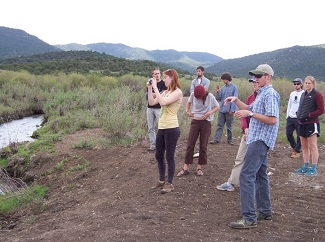
Conditions present at this site provided the students with a “before and after” glimpse of stream restoration. The entire site was walked from the degraded section, downstream to a recently restored segment that included in-stream rock structures and willow transplants.  I was impressed by the quality of questions and general interest of the students. I could tell that they were genuinely interested in the project and excited to be in the field observing actual conditions. The tour concluded with a question and answer portion that included questions about the history of the watershed, background information, and restoration procedures. Each correct answer yielded praise from fellow students and the grand prize of a………TU t-shirt!

KerberCreekJWillis3The tour consisted of a unique group of students in that a majority of them were pursuing different forms of environmentally based degrees. In my opinion, this proved for a well-rounded tour and a broader range of questions asked by the students. It was great to see that they really appreciated the tour and the opportunity to see actual stream restoration. TU would like to thank both programs of CC and UCCS for the opportunity to help educate and inform the students about the importance of preserving our local ecosystems and watersheds. If the group that attended this tour is any indication of the quality of future ecologists, engineers, biologists, and scientists then I feel inclined to say that successful efforts to conserve, protect, and restore North America’s coldwater fisheries and their watersheds should continue for years to come.

- Jason Willis, Mine Restoration Field Coordinator Colorado Abandoned Mines Project, Trout Unlimited