Conservation

Alpine Triangle

Protection plan an intriguing proposal Durango Herald

Ty Churchwell, who is leading the effort for Trout Unlimited, put it this way: “We want to form a coalition that includes counties and municipalities, watershed groups, sportsmen, private landowners, recreational-vehicle groups and the Durango & Silverton Narrow Gauge Railroad. They all have an interest in preserving our heritage and our economic viability."

It is an ambitious goal and a worthy one. But by taking an inclusive approach, both with the supporters he wants to attract and by not neglecting any current users' interest in the land, it may well be achievable.

For good reason, some things are banned in some places. True wilderness, for example, is incompatible with motorized traffic. But preserving the Alpine Triangle does not mean locking it away or curtailing its use by the public. Preservation in this context means just what its supporters say: Keep it like it is.

It is a goal that deserves support.

http://durangoherald.com/sections/Opinion/2010/03/05/Alpine_Triangle/

Plotting the Alpine Triangle

Trout Unlimited looks for support in protecting 126,000 acres in San Juans

by Dale Rodebaugh Herald Staff Writer

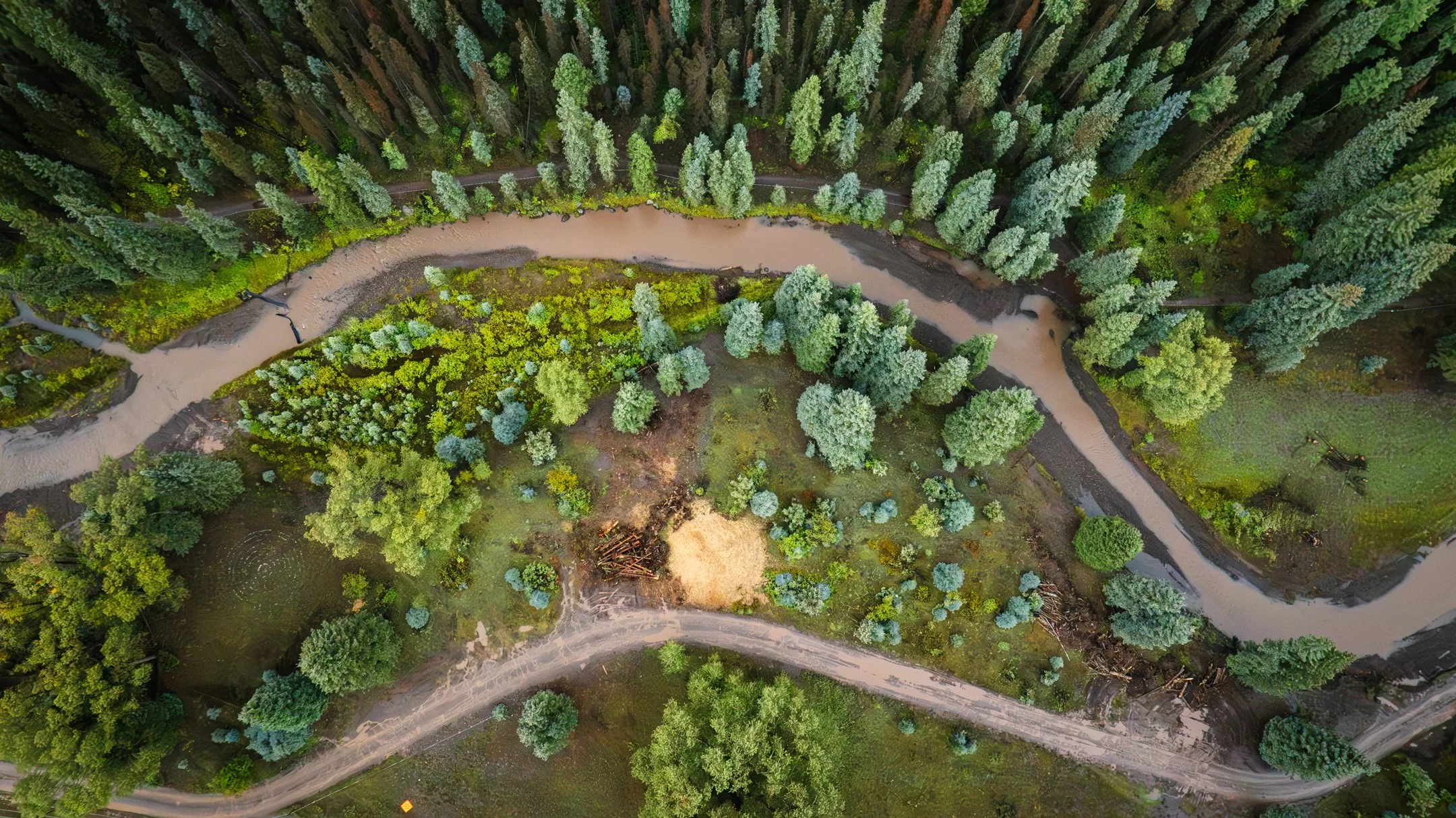
A national river-conservation group is drumming up broad support for congressional protection of 126,000 acres in the San Juan Mountains where, a spokesman says, spectacular scenery, remnants of a rough-and-tumble past and recreational opportunities make the area a virtual paradise on Earth.

“The area is one of Colorado's most unique off-road and backcountry resources," said Ty Churchwell with the Five Rivers chapter of Trout Unlimited in Durango, who is heading the preservation campaign. “Our motto is 'Keep It Like It Is.'"

The target area - anchored by the towns of Silverton, Ouray and Lake City - is called the Alpine Triangle, although the shape more resembles a polliwog, with a long tail heading northeast down the Lake Fork of the Gunnison River. This high-country terrain, Churchwell said, attracts 300,000 visitors annually who hunt and fish, admire towering peaks and wildflowers, explore 195 miles of four-wheel-drive roads, camp and backpack and visit old ghost towns and abandoned mines. The number of visitors doesn't include those who arrive in Silverton by train, he said.

“We want to form a coalition that includes counties and municipalities, watershed groups, sportsmen, private landowners, recreational-vehicle groups and the Durango & Silverton Narrow Gauge Railroad," Churchwell said. “They all have an interest in conserving our heritage and our economic viability."

http://durangoherald.com/sections/News/Earth/2010/03/04/Plotting_the_Alpine_Triangle/

National Conservation Areas: A primer

by Dale RodebaughHerald Staff Writer

National Conservation Areas, designed to protect cultural, historical and recreational assets, range in size from 19 acres to 799,000 acres. The U.S. Bureau of Land Management's 10-year-old National Landscape Conservation System, which includes the conservation areas as well as national monuments, wilderness areas and wild and scenic rivers, protects 27 million acres at almost 900 sites.

The National Conservation Area label that Trout Unlimited wants for 126,000 acres near Silverton called the Alpine Triangle would be the fourth such area in Colorado overseen by the BLM.

http://durangoherald.com/sections/News/Earth/2010/03/04/National_Conservation_Areas_A_primer/

Public input sought on Gross Reservoir expansion

By Laura Snider Camera Staff Writer Denver Water plans to make up almost half of its projected water shortfall in 2030 with water conservation methods, which is laudable, according to Drew Peternell, director of Trout Unlimited's Colorado Water Project.

"I think Denver deserves credit for good conservation," he said. "But more can be done."

Peternell said Denver Water should look at other ways to meet its growing demand -- including more water-reuse projects and agriculture water-sharing arrangements -- before sucking more water out of tributaries to the Colorado Rivers, including the Fraser.

"The Fraser River is the river in Colorado that is the most heavily depleted," Peternell said. "It's just really beat up."

http://www.dailycamera.com/boulder-county-news/ci_13885451

Citizens urged to weigh in on Denver proposal to divert more water from Fraser River

By Tonya BinaSky-Hi Daily News Grand County, CO Colorado

“Multiple water diversions have pushed the Fraser River to the brink of collapse,” said Kirk Klancke, president of the Colorado Headwaters Chapter of Trout Unlimited.

TU, the Colorado Environmental Coalition and a broad group of conservation organizations warn that a proposal to divert more water from the Fraser, a tributary to the Colorado River, poses a serious risk to the ecological health of the river system.

Denver Water looks for more mountain water

By Bob Berwynsummit daily news

“Front Range residents must recognize the connection between our water use and the health of our rivers and streams, fisheries and wildlife habitat,” said Colorado Trout Unlimited director Dave Nickum. “We can't continue to take and take from these rivers without accounting for our impacts. The glass is not even half full. It's almost drained dry.”

http://www.summitdaily.com/article/20091128/NEWS/911279987/1078&ParentProfile=1055

Upper Colorado River, Front Range water resources threatened

Colorado Independent
By David O. Williams

Some water experts warn the upper Colorado River is an endangered species if current residential growth patterns and water consumption patterns continue along the state’s Front Range, and they’re increasingly concerned proposed energy production on the Western Slope will accelerate its demise. Ken Neubecker, president of the state counsel of Colorado Trout Unlimited and a member of the Colorado River Basin Roundtable, points out that already 64 percent of the upper Colorado River above Hot Sulfur Springs in Grand County is diverted across the Continental Divide to the Front Range population centers of the state.

http://coloradoindependent.com/41558/upper-colorado-river-front-range-water-resources-threatened

Rapp named Trout Unlimited’s conservationist of the year

Clear Creek Courant Since the discovery of gold in 1859 in Clear Creek County and neighboring Gilpin County, it is doubtful that any Colorado body of water has been under more influence from historic mining activity than Clear Creek.

During the Gold Rush era, an estimated 1,600 or more active mines were developed, with nearly all of those since abandoned.

Over the years, these orphan mines and related mine waste residuals have had negative impacts on the local fishery. Clear Creek’s revival began in the late 1980s, about the time that Ed Rapp arrived on the scene.

Rapp is being honored as Colorado Trout Unlimited’s conservationist of the year.

http://www.lcni5.com/cgi-bin/c2.cgi?040+article+News+20090428174748040900

Thanks to Coyote Gulch for the link.

PitCo seeks to leave more water in Roaring Fork

by Brent Gardner-Smith, Aspen Daily News Staff Writer

Pitkin County is taking unprecedented steps to keep more water flowing down the Roaring Fork River for environmental purposes.

In November, county voters approved a 0.1 percent sales tax worth $1 million a year to create a “healthy rivers and stream fund” to “secure, create, and augment minimum stream flows.”

“I am not aware of any other Colorado county putting in place a tax similar to what Pitkin County has done,” said Linda Bassi, the chief of the Stream and Lake Protection division of the Colorado Water Conservation Board (CWCB). Ken Neubecker, the president of Colorado Trout Unlimited, also supported the trust agreement between the CWCB and Pitkin County.

“I do think it’s a good idea to have such a trust, whether it’s with the CWCB or the Colorado Water Trust,” Neubecker said. “We need to have financial vehicles where money can be raised for acquisition of in-stream flow water.“

http://www.aspendailynews.com/section/home/131954

Colorado's water future: a cup half-full

By Richard Stacy There are going to be major changes along the Front Range by 2030.

According to the Colorado Department of Natural Resources, the state's population is expected to increase by about 2.8 million to a little over 7 million people. Most of the increase, about 2.4 million, will live along the Front Range. The population increase will have huge impacts in too many ways to count — but one of the biggest challenges will be with respect to our water supply.

The increased population translates into a total increased annual demand of about 630,000 acre-feet, 450,000 of which will be needed for the Front Range. To put that in perspective, Dillon Reservoir holds only 254,036 acre-feet. We need to find a lot of extra water somewhere.

http://www.denverpost.com/opinionheadlines/ci_11266634